
What makes a topic controversial? Is it your political belief? Is it based on how many viewpoints there are? Does there always have to be a correct answer? These were some of the questions I asked myself when I was considering what topic to choose for my argument. Although the questions have no real answer, it was a good way for me to think about what topics would be considered good. After an extended period of stressful brainstorming, I finally concluded that the ideal controversial subject has to be one that is not so black and white. What makes a subject most controversial is that it needs to be a topic that, when supported with the right evidence, somebody could make a case either for or against it. The topic that I felt best fit this description was the argument on gun control. The gun control argument is one that is very difficult to moderate. There are people all over the spectrum in regards to whether or not people should own guns. On top of that, no matter what actions are taken to either promote or knock the ability to own guns, it seems that there is no real way to appease everyone. Everyone seems to have a strong opinion in the gun control argument, regardless of whether or not they are around them or really care about them. The argument at hand is very simple; should the government increase the number of laws regarding guns or not. According to New York Times, in recent years, gun control debates have focused primarily on background checks for buyers, whether or not people should be allowed to carry weapons in public, and whether to allow the people to own assault rifles.
Pro Gun Control
In an article on Impact Fund, a website where progressive advocates stand up for economic, environmental, and social justice, writer Kelsey Rogers tells the tragic story of a high school basketball player whose career was greatly affected by gun violence. The boy she writes about in her story, Danny Williams, was a rising junior in high school from Buffalo, New York. While playing basketball outside of his house one day, his ball bounced into his neighbor’s yard. When he went to go pick it up, out of nowhere, a car drove up and a gun emerged from the driver’s side window. The shooter then fired a bullet into Danny’s abdomen. Although Danny survived the incident, his dreams of playing basketball at the next level did not. Where this story raises debate, is the fact that Danny’s shooter, a gang member who had mistaken him for somebody else, had purchased the weapon illegally through a gun trafficking ring at an Ohio gun show. This gun was only one of over 140 semi automatic handguns sold from this show. The ability to buy a gun with such ease is a substantial issue and it is one of the main arguments of why people believe gun control should increase. Had there been greater laws that better restricted the shooter’s ability to get a gun, Danny would still be playing basketball and achieving his greatest goals and aspirations. However, Danny is not the only person that has ever fallen victim to gun violence.

Gun violence has become a large issue in America in recent times and many believe that the only way this may be solved is through greater gun control. If people are stripped of their weapons, or if they are denied access to certain types of firearms, then gun related crimes would have no choice but to drop as people wouldn’t have access to the issue. An article in the Washington Post by Robert Gebelhoff lays out a number of steps that can be taken to end the war on guns. First, it is a necessity to ban weapons of war. Although banning assault rifles was never meant to reduce overall gun deaths, it was meant to reduce the number of deaths from mass shootings. Therefore, this ban would not exactly end gun violence, but it would keep more dangerous weapons from being used in crimes, which is a good place to start. Another step that the Gebelhoff offers in an attempt to lower gun related crimes, is to strengthen background checks. As of now, background checks are required by federal law, however, they’re not difficult to slip past. That is because the background checks are only required when purchasing through a licensed dealer. Private individuals and online retailers do not require these checks. This means that many gun owners, 42% of them in 2017, did not undergo any background checks before obtaining a firearm. Without greater gun control laws, convicted criminals and other individuals who should not receive access to these weapons, are still able to get one. It is obvious why this is an issue as these are the exact types of people who should be banned from having anything like this in the first place. The third step laid out by Gebelhoff is that the government needs to stop the flow of guns. As simple as it sounds, this would help as the more guns there are, the more gun deaths there will be. A 2013 study from Boston University found that for every percent increase in gun ownership at the state level, there was a 0.9 percent rise in the firearm homicide rate. This means that for every additional gun owned by somebody in America, there was a firearm homicide to match it. Some ways that the country may go about decreasing the flow of guns could be; instituting a buyback program, limiting the number of guns that someone can buy at one time, and holding gun dealers more accountable of who they sell guns to. Instituting a buyback program has proven successful before in Australia. In the 1990s, Australia spent $500 million to buy back almost 600,000 guns. Harvard University researchers found that in the seven years following, the gun homicide rate dropped 42 percent and the gun suicide rate fell 58 percent. Limiting the number of guns that a single person can buy at once would be of big help too. Studies from what is now called the Bureau of Alcohol, Tobacco, Firearms and Explosives (BATFE) show that as many as 1 in 5 handguns recovered in a crime were originally purchased as part of a sale in which multiple guns were purchased. If people were limited to one gun per month or so, then there would be less guns in circulation and people wouldn’t buy and sell guns illegally at such a fast rate. Finally, gun dealers should be more accountable of who they sell guns to. If a dealer sells a gun to somebody who they believe seems suspicious and a crime is committed with that gun, the dealer should have to serve some sort of punishment. This change would make dealers second guess everyone that they sell guns to, and sales would only be made if they were safe.
Anti Gun Control
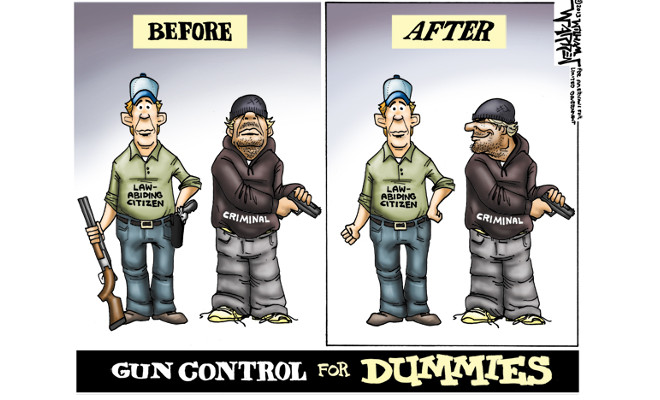
As bad as some people want increased gun laws, there are still people on the other end of the spectrum who believe increased gun control laws are unnecessary. Furthermore, people challenge the idea of gun control in general. In an essay on Sage Journal, author Gary Kleck raises the question of whether or not gun levels should affect the rate of crime and violence. Gun control laws are intended to reduce crime and violence rates by keeping guns away from those who are more at risk of committing a crime using one. Although some laws attempt to do this by reducing gun levels in public, neither the federal government or any state has ever banned the ownership of guns. Further, research indicates that existing laws have no measurable effect on overall gun ownership levels in the population as a whole. Instead, gun laws are intended to stop trade, possession, and criminal use of guns by convicted criminals, mentally ill persons, alcoholics, or drug addicts. Because criminals, mentally ill persons, and alcoholics are already denied access to guns through background checks, increased gun laws would only keep those suitable to owning one from getting one. Some even argue that increased gun control laws could increase crime. By disarming possible future victims of violence, their ability to defend themselves reduces greatly, and any deterrent effect that the victims’ gun may have possessed towards the offender is gone. There is more to why guns can be looked at as good. News headlines are always filled with reports of gun violence and crime. While we hear about these murders and accidents all the time, what we often don’t hear about is the crimes stopped because of guns. People do not hear about times where would-be victims took a gun out and scared a criminal away. These failed crimes and saved lives usually aren’t reported to police, and when they are reported, the media tends to ignore them. This is because media producers have grown to realize what kind of news sells better than others.
In the End
In the end, the gun control debate is one that may never fully conclude. There are valid arguments to be made across the board, whether it be for or against gun control. One thing that I found interesting while doing this assignment however, was how much easier it was to find articles regarding increased gun control. I believe that this is a direct result of how times are changing and how it is slowly becoming the societal norm to feel strongly against guns because of all of the violence going on in this world. This just magnifies the need to “map out” controversies such as this one so that people may be able to gain a solid understanding of topics before they argue them.
Sources
Gebelhoff, Robert. “Opponents of Gun Reforms Say Nothing Can Be Done. Science Says They’re Wrong.” The Washington Post, WP Company, 2018, http://www.washingtonpost.com/graphics/2018/opinions/gun-control-that-works/.
Kleck, Gary. “Does Gun Control Reduce Violent Crime? .” SAGE Journals, 2016, journals.sagepub.com/doi/pdf/10.1177/0734016816670457.
Pérez-peña, Richard. “Gun Control Explained.” The New York Times, The New York Times, 7 Oct. 2015, http://www.nytimes.com/interactive/2015/10/07/us/gun-control-explained.html.
Rogers, Kelsey. “Gun Violence – We’ve Had Enough!” Impact Fund, Impact Fund, 6 Oct. 2015, http://www.impactfund.org/social-justice-blog/gun-violence-weve-had-enough?gclid=Cj0KCQiAwMP9BRCzARIsAPWTJ_GyRWEg3UdAcSEPyKG-496UaXRJhSgmq3V1s3q-BS66SvQwHI-tVO4aArTrEALw_wcB.
Stossel, John. “Why Guns Are Good.” Fox News, FOX News Network, 12 Nov. 2014, http://www.foxnews.com/opinion/why-guns-are-good.
 Cosner Rhetoric