
Abortion is a very controversial topic in our world today. Perspectives on abortion differ and the conversations tend to become less civil due to the strong values individuales hold close to them. These values stem from multiple beliefs; whether it be from religion, family, or friends. On one side people believe in the freedom of choice and that a women should not be withheld the right to choose. However, others believe that abortion is murder and that even a fetus is a human being that deserves to have a life. Due to these beliefs there is a strong conflict of opinion, which causes women to feel pressured into what kind of path to go down on.
One way women feel pressured with their decision on abortion is the opinion of their family. Family members can be very controlling and they have a strong influence on what that person will do. This influence can cause many conflicts to occur within a family and the topic of abortion can severely damage relationships. During a Ted Talk about abortion Josiah Friedman, the founder of the prominent movement Voices for the Voiceless, speaks at Grand Canyon College about how women should not face unplanned pregnancy alone. Within this Ted Talk Josiah explained that abortion is not wrong or immoral but it is a “void for connecting” (Friedman). Within this Ted Talk Friedman gave many examples to project his message to his audience but there was one example in particular that really expressed his points. He explained that when his mother was 19 years old she became pregnant but chose to get an abortion because of her father. Friedman’s mother felt her father would cut all connections and disapprove of her and her husband. She felt forced to get an abortion and never tell her father. After the procedure she experienced unnatural bleeding and went to the hospital and later received a bill stating the bleeding was from post abortion. Luckily she got to the bill before her father and begged the hospital to change it so her dad would not find out. They agreed and he never ended up finding out the truth. This is one of hundreds of examples that Friedman has about women being pressured into getting abortions. The decision that Friedman’s mother made was solely because of her family and the pressures she felt from them. This example from Friedman really helped capture his message and emotions towards abortion. His perspective is that people’s views need to change and that abortion is not immoral it is a positive resource but because of judgments it is looked down upon.
Nick Anderson, a political cartoonist for the Houston Chronicle expressed a different perspective towards abortion through one of his cartoons.
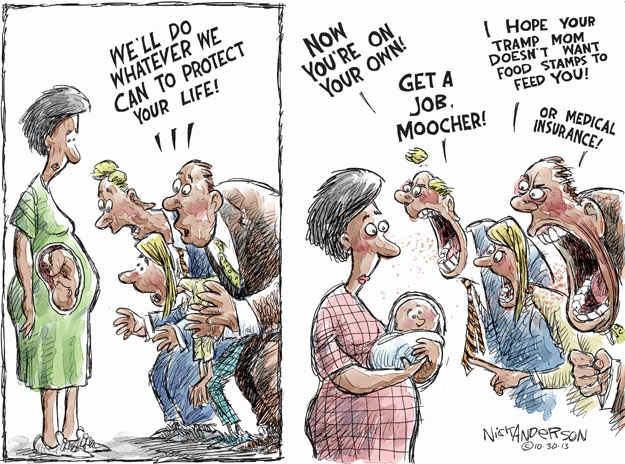
In this cartoon Anderson shows similarities and differences to Friedman. Anderson’s perspective on abortion shows similarities to Friedman’s perspective because in this cartoon we can clearly see the family being supportive while the women is pregnant but once she has the baby we see the family getting extremely angry and judgemental. Just like Friedman this cartoon by Anderson also explains how there are too many pressures and too many opinions from outsiders when it comes to the topic of abortion. However, Anderson’s cartoon also differs from Friedman’s point of view because in this cartoon we see the family delivering pressure and judgments once the women has had the baby as opposed to Friedman’s perspective where the pressures and judgments come in the beginning stages of pregnancy. In the second part of the cartoon the father is visibly expressing strong emotion towards the daughter. On her face we can see Anderson drew red to show that she feels embarrassed and ashamed. Anderson specifically did this to demonstrate how the judgments and pressures make the women who are pregnant feel. When women feel these pressures from their family it truly affects the course of their life and takes a toll on them.
A Polar opposite perspective from Friedman’s and Anderson’s views is expressed by Samuel Sey. Sey, a community liaison at the canadian centre for Bio-Ethical Reform, explains that when someone gets an abortion they are breaking the rules of God and in fact slaughtering human beings. People’s perspectives on abortion tend to be strongly associated with religion and that person’s beliefs. Religion is not only strongly associated with peoples perspectives on abortion but religion also creates a passion that drives people to get very aggressive with their point of view. This is strongly demonstrated in Sey’s writing. In Sey’s article, “Murders That Won’t Go Viral“, his tone is very explicit and aggressive. He purposely dives deep into the truths and horrors of abortion to really grab his audience’s attention and show them why abortion is wrong. In this article Sey states, “Abortion crushes the babies head. It rips them apart, limb by limb” (Sey 1). Due to choosing these specific explicit words we see how passionate he is towards his argument. Also because of his specific word choice and tone we can come to the conclusion that if someone with an opposing view discussed this topic with Sey he would respond more aggressively and harsh therefore not tolerating any alternate view points contributed to the discussion. Sey through his writing heavily appeals to his audience through religion. While discussing why abortions are murder he states “Our God says, Rescue those who are being taken away to death, hold back those who are stumbling to the slaughter” (Sey 1). Sey believes that there is a strong connection between his view point and religion. Many other individuals make this connection causing them to be stubborn with their viewpoints and not open to any suggestion. Sey’s opinions strongly differ from Friedman and Anderson’s perspectives because they feel that a women deserves a choice where Sey strongly believes in religion and that abortion is killing a live human being and that abortions were not meant for this world.

Abortion plays a large role in the psychological state of a women. Although the main debates are whether abortion is right or wrong the procedure, stress, and decisions can really traumatize a women. Lisa Tolin, an experienced journalist and editor for TODAY digital, covered a study about the psychological after-effects of abortion. In her article “The Effects of Abortion“, psychologists Nancy Felipe Russo Ph.D. of Arizona State University, and Amy Dabul, Ph.D., of Phoenix College discussed that the best way to understand a women’s mental health after the abortion is to know her state of mind previous to the pregnancy. while discussing their findings Tolin states “In other words, those who found the procedure traumatic were generally troubled long before they showed up at an abortion clinic” (Tolin 1). While women are in this fragile state they are very vulnerable and stressed. This makes it extremely hard because while they are going through all of this they have friends and family trying to tell them what to do and what not to do. All of these factors and pressures feed into a women’s mental state making it very hard and frustrating for them. The overall process of abortion and unplanned pregnancy can be traumatic and leave women in a poor psychological state. In addition to discussing a women’s mental state this study heavily contrasted Sey’s article and his views. This study conducted by Nancy and Amy found that the women’s affiliation to religion had no effect on them getting an abortion. Women of the catholic religion were just as likely to get abortions as women of a different religion.
All together there are many perspectives on abortion that differ. After reviewing these four sources conflicts of opinions are very visible and has a strong effect on our society. Although all of the sources share different viewpoints on abortion they all connect together in some way. There is never going to be a correct answer on whether abortion is right or wrong but societies viewpoints can become more open and understanding to make it easier on the women going through this unexpected and stressful time.
Worked Cited
 Cosner Rhetoric