The minimum drinking age has been set to twenty-one years of age for the past thirty-six years with respect to public safety. Some however, question the change as things aren’t much different from before the passing of the law. Everyone can come to the understanding that alcohol can and will be abused no matter what, similar to that of any other substances capable of inhibiting cognitive and physical functions. It’s when it comes to putting an age limit on alcohol is where the argument starts. Some believe that lowering the drinking age would lead to a more controlled and responsible attitude towards alcohol. Others believe that it would be medically irresponsible to lower the age because the brain hasn’t finished developing until at least 21 years of age. The issue seems to further complicate itself when no clear answers can be found on either side especially not when it comes to which age to decide upon.
In the article “should drinking age be 18” by Annie Chiappetta she takes a dive into the complex nature of the whole situation citing evidence from both sides of the discussion allowing the reader to formulate their own intuitive positions. She happens to put a large focus on state representative Richard Marron who happens to be against the age limit of 21 and makes multiple claims in which the age of 18 makes considerably more sense in the grand scheme of things. Marron’s main argument that Chiappetta outlines in her essay is “It just doesn’t sit right with me that people [at the age of 18] have the right to do everything else, including serve their country, but don’t have the right to consume alcohol, It’s a form of age discrimination.” (Chiappetta). What Marron is trying to get at here is the seemingly silly nature of the fact that eighteen-year old’s have the right to do literally everything but buy alcohol. I find it effective for him to point out the idea that it simply makes no logical sense to him whatsoever and this is particularly effective because it gets you as the reader to analyze the preposterous nature of this law as well. One segment of this article that makes it particularly effective is when she quotes Marron’s beliefs on federal government “federal government intruding where it doesn’t belong. Federal highway funding shouldn’t be tied to whether or not someone is able to drink.” (Chiappetta). This quotation hits two main points it again emphasizes his argument on the ridiculous nature of it all, but it also could potentially hinder the overall strength of his claim. By Chiappetta providing Marron’s personal opinions on the intrusion of the federal government this very quickly takes on a political tone. The inclusion of this has the potential to hinder the effectiveness of his argument for those who hold opposing beliefs in relation to federal powers but similar beliefs in relation to the drinking age. The article in its entirety does an excellent job of outlining the oppositions argument as well as the debate as a whole. It not only makes the opposition’s point clear as well as the main focus in the article but also include the numerous absences in their claims leaving the reader informed on the opposition argument all the while remaining neutral in its entirety.
Another text very similar in nature but with the exact opposite viewpoint would be an article by German Lopez “Sorry, college students, but the drinking age should stay at 21”. This article dives into the claim that the age limit of twenty-one is very effective and there are numerous reasons as to why its twenty-one as well as why it most definitely shouldn’t be lowered. The article starts with the exact same argument that was posed in the article above about how everything else is legal at 18 but poses it in question form. By doing so it not only acknowledges the other side’s argument but sets it up nicely as to why it’s not a great claim. The first piece of evidence presented to the reader is strong and undeniable “the National Minimum Drinking Age Act of 1984, which raised the legal drinking age from 18 to 21: It found that the number of fatally injured drivers with a positive blood alcohol concentration decreased by 57 percent among ages 16 to 20, compared with a 39 percent decrease for those 21 to 24 and 9 percent for those 25 and older.” (Lopez). This is an extremely effective approach to his argument it presents us with clear and undeniable proof that the increase in the drinking age has had positive effects in the long run. He further develops this evidence by providing the example of New Zealand and how they did the exact opposite, lowering the drinking age causing accidents and deaths to rise overall. This also strengthens his argument a great deal making it non-linear and even more undeniable boosting credibility. One of his more noticeable points is when he delves into the topic of access to alcohol, he doesn’t believe that it will eliminate underage drinking, but it does however greatly deter it “If the drinking age were 18, someone who is a freshman or sophomore in high school is much more likely to have access to an 18-year-old senior in high school. But if the drinking age is 21, a freshman or sophomore in high school is not going to have as easy of access to a 21-year-old who’s likely working or in college.” (Lopez). Another seamlessly undeniable point that he presents the reader with getting them to think complexly about how lowering it could lead to a multitude of other negative side effects. The Article in full addresses both sides but makes the argument that there are reasons and evidence that back the drinking age of 21 and why it should stay like that currently.

We then can move onto the oppositions argument once again this time in an interviewed form that more personable. The video begins with those opposed to the twenty-one year old mandated drinking age outlining the various reasons as to why lowering the drinking age would cause a significantly better relationship with alcohol overall. The first person in opposition to the law is a police chief, he emphasizes the large number of drinking tickets he gives out and how they have no effect on the culture behind drinking he even goes on to say that it creates a significantly negative relationship between drinking and law enforcement. He outlines the fact that it pushes drinking into underground and uncontrolled environments as well as a large presence of consuming it at alarming rates in private so that when they go out in public law enforcement has no jurisdiction over them. Gordy bailey’s parents are the second advocates for the lowering of the drinking age they believe their son’s death was extremely preventable, but it was the fear that the law imposed upon them that withheld them from taking action. By presenting the argument of the opposing side in such a way that starts with a logistical approach followed by an anecdote it allows the reader to process the information at a slower rate. Their soon hit with a heartbreaking story that really closes in on the argument in an attempt to play on the audience’s sympathy making it significantly easier to side with the opposition. Overall, the video tries to get you to acknowledge the negative effect that this law imposes on the culture around drinking by pulling on your heartstrings a little and backing it with logistical and analytical support.
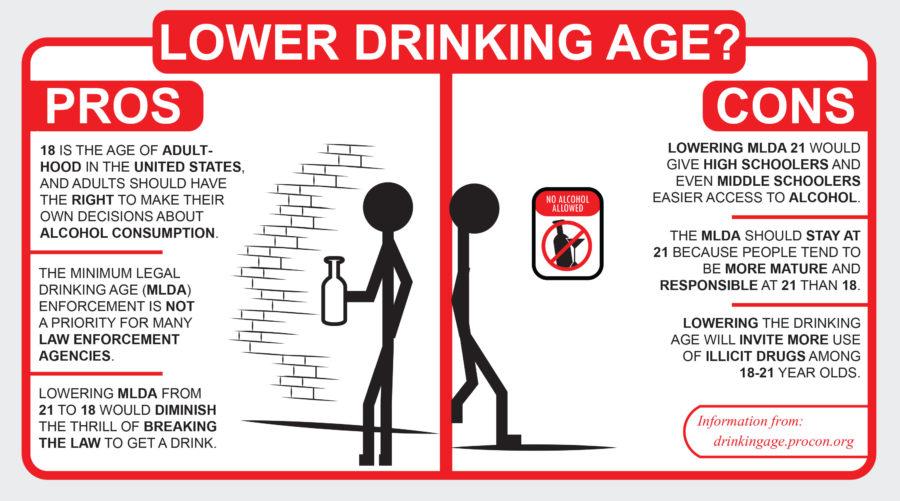
In the next text we can see a total reversal of the ideas and warrants presented above. This article dives into the debate of the drinking age is written by Allie Bidwell over at us news. This article takes an interesting perspective on the debate it begins with a professor at the University of Boston school of public health making the claim that in fact the high drinking age is effective and should be enforced but it doesn’t stop there he even goes as far as to claim that his opposition it blatantly wrong and have no facts whatsoever to merit their opinions “DeJong says there is no such evidence to support that claim, and nearly all research conducted on drinking-age laws proves the opposite” (Bidwell). By outright staring the oppositions points or invalided it shows that he confident and direct in his approach to his research, it increases his credibility and makes it easier for the reader to jump onto his side that is so “blatantly right”. This could also however, be seen as a weakness reader who find themselves on the opposing side of this argument may be thrown off by his very direct and confident remarks regarding his research. It may even lead them to dismiss clear and concise facts that he has presented because they are blinded by his aggressive dismissal of their opinions.
The last article we’ll look into today is one that is particularly insightful, written by Will Wilkinson of Forbes magazine. This article is riddled with personal opinions but nonetheless, they are backed and supported with logistical and well-articulated reasoning and evidence. Wilkinson sets himself up for a successful argument right from the start by drawing attention to the seamlessly disconnected nature of the overall argument “the debate is so bizarrely fixated on automobiles and the automobile infrastructure. But this debate should be about the desirability of a culture that fosters freedom and responsibility, not about cars and how many people of what age die in them.” (Wilkinson). By formulating his argument in this nature he eliminates a Huge proponent of the opposing sides argument, quite frankly the only point the opposition uses to their advantage. In doing so he not only dismisses their argument but sets up his own claim in a way that shifts the discussion as well as making it difficult to counteract. He then backs up his argument by delving into the culture/stigma that surrounds drinking and how it a truly does more harm than good “”If you’re not 21, it’s not Miller Time–yet.” Age limits make drinking a badge of adulthood and build in the minds of teens a romantic sense of the transgressive danger of alcohol. That’s what so often leads to the abuse of alcohol as a ritual of release from the authority of parents.” (Wilkinson). He makes it evident that the drinking age alone is the culprit in the stigmatization of alcohol. This is extremely effective in relation to his original claim of eliminating the age limit all together because it outright states that the limitation on such principals will cause a retaliation no matter what age is applied. One piece in which he may fall short in his overall effectiveness is when he brings up the example of Denmark, he sites them as having a lower drinking age in comparison to the United States it’s in his breakdown of this information where readers may sway “the world’s happiest country and scores third in the United Nation’s 2007 ranking of child welfare. In the UN listing the U.S. came in 20th out of 21 wealthy countries.” (Wilkinson). In presenting the reader with these facts Wilkinson is effectively saying that the two most important things to look at are a countries overall happiness as well as their child welfare rankings. In doing so he allows the reader a significant amount of wiggle room now to rebuttal his argument because as it happens to be, valuing those two things at the top are undoubtedly formulated by personal opinions that hold no warrant whatsoever. Wilkinson’s overall piece happens to be very insightful with clear and articulate points and it is through his immediate and warranted rebuttals that we can find his overall claim to be affective and agreeable.
The drinking age has been a focal point for debate for years now and will continue to be in years to come. Its lack of hard evidence in support of either side is the culprit in the debate here. The debate finds itself taking on and ideological approach rather than a scientific and factual approach neither side has enough indisputable hard evidence to make a clear point and this is the ultimate downfall of the debate. The laws that we find ourselves imposing today may be wrong and this is the ultimate fear however, we unfortunately have no way of knowing. This is due to the fact that the experimentation of public safety is not something to be taken lightly and will forever be a hindering component in this argument.
work cited:
Banzon, Austin. Lower Drinking Age? 6 May 2016.
Bidwell, Allie. “Study: The Debate Is Over – Higher Drinking Age Saves Lives.” U.S. News & World Report, U.S. News & World Report, 24 Feb. 2014, http://www.usnews.com/news/articles/2014/02/24/study-the-debate-is-over-higher-drinking-age-saves-lives.
Chiappetta, Annie. “Should Drinking Age Be 18?” ABC News, ABC News Network, 7 Jan. 2006, abcnews.go.com/US/story?id=667917.
Hewitt, Don, director. Drinking Age Debate . 60 Minutes: Some Say Age Should Be Lowered To 18, But MADD And Others Strongly Disagree, CBS, 19 Feb. 2009, http://www.cbsnews.com/news/the-debate-on-lowering-the-drinking-age/.
Lopez, German. “Sorry, College Students, but the Drinking Age Should Stay at 21.” Vox, Vox, 19 Jan. 2016, http://www.vox.com/2016/1/19/10761802/drinking-age.
Wilkinson, Will. “Bottoms Up!” Forbes, Forbes Magazine, 16 July 2012, http://www.forbes.com/forbes/2008/0929/028.html?sh=305c5c127192.
 Cosner Rhetoric