
Alcohol. It’s what seems to be the forbidden fruit for many American teenagers until they reach the ripe old age of 21. Compared to the rest of the world, 21 seems a bit late to finally allow citizens to indulge in alcohol. Many European countries allow their taxpayers to legally buy and consume alcohol at age 18, some even as low as 16 years old (“Minimum Legal Drinking Age in Other Countries”). To many, it seems only natural that the U.S. should follow in the footsteps of the rest of the world and change the drinking age from 21 to 18, but to others, the 21-age stamp is here to stay.
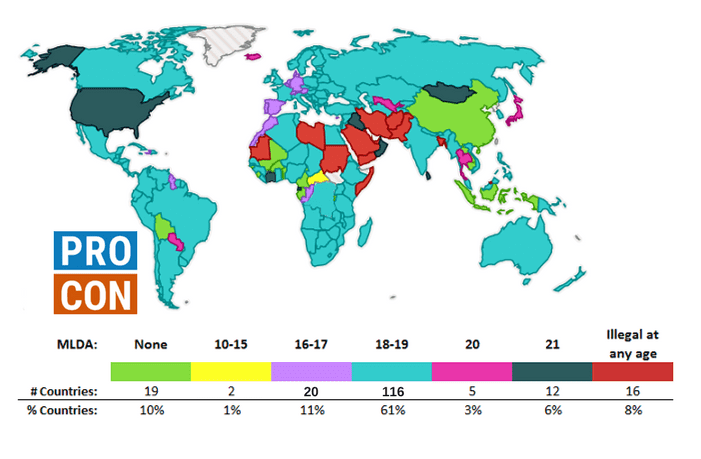
The drinking age is something of a continuous hot topic throughout America. It seems silly to many that at 18, someone can join the military, but they can’t join their buddies for a drink at the bar. They can get married, but they can’t celebrate with a glass of champagne. Many people against the idea of lowering the drinking age shake it off that it’s only teenagers who want this. That they want to be legal so they don’t have to keep sneaking around. While that may be true, and a large majority of the supporters for lowering the drinking age are in a relatively younger age bracket, there are many older adults who seem to feel the same. One in particular being 81 year-old Dr. Ruth C. Ensburg, a professor at Indiana University’s School of Public Health. At the beginning of this paper she wrote, “Why the drinking age should be lowered: An opinion based on research”, Dr. Ensburg does an effective job at establishing ethos. She’s researched this opinion she’s had for 30 years and has become somewhat of an expert in the topic. Throughout this essay, there are also many compelling statistics revolving around the use of alcohol and college students. This use of statistics enhances her claim that lowering the drinking age would be beneficial for the health of college age students. A particularly interesting statistic was that 22% of alcohol consumers under the age of 18 are considered to be heavy drinkers. This is compared to the 18% of people that reported consuming the same amount, but are legal drinkers (Ensburg). It seems to be that by raising the consumption age to 21, the American government has pushed unhealthy and irresponsible drinking habits on young adults. Later on in her essay, Ensburg covers the topic of responsible drinking. She goes to mention that because America has raised the legal drinking age, it has created an era of irresponsible drinkers. Percentages of unsafe and reckless acts have risen since the implementation of MLDA, the mandated legal drinking age (Ensburg). Another author, Kynslie Otte seems to agree with Ensburgs points. Otte points out that just because MLDA was enforced, it doesn’t mean that underage drinking stopped. The National Center on Addiction and Substance Abuse recorded that underage drinking is responsible for 17.5 percent of consumer spending on alcohol. MLDA didn’t stop the purchasing of alcohol, all it did was make young adults sneakier with their ways of purchasing and consuming alcohol. It pushes college students to more unsafe methods of drinking. Instead of being able to sit in a supervised bar or restaurant, college kids go to unsupervised house and frat parties where drinking and drug use is common. This can lead to injuries or situations that kids are too afraid to report to the authorities (Otte). Both of their articles target pathos, with their main point being it will keep kids that partake in these activites safer. These two articles corroborate with each other’s findings, making a compelling argument that lowering the drinking age, would in fact, be more beneficial for the younger generations’ health. I found a third article that is also in agreement with the articles I talked about above. Gabrielle Glaser published her article, “Return the Drinking Age to 18, and then Enforce it”, in the New York Times. She goes on in her article to explain how lowering the drinking age, would benefit the health of the younger population, which seems to be the reoccurring theme for people to talk about when talking about lowering the drinking age. Glaser talks about the rise in alcohol themed deaths in her article as well. She briefly mentions traffic deaths and chooses to focus more so on alcohol poisoning deaths, as well as the rise in hypothermia cases and falls. During the years of 1998 and 2005, the amount of alcohol poisoning deaths in 18 to 24 year olds, almost tripled, going from just 779 cases to a whopping 2,290 (Glaser). I find this statistic particularly interesting because Glaser chose to include ages that were over 21. Most people would think that because someone is 21, they understand how to drink responsibly, but that’s just not the truth. Glaser makes an interesting analogy in her conclusion paragraph about how society doesn’t just let a new, 14 year-old driver drive alone. They need to have an adult in the car, go through a whole class to get their license, and so on, so why is that not the case with drinking (Glaser)? Surely if kids were able to drink in a controlled setting and learn how to do it responsibly, there would be less problems related to alcohol consumption in our world.
However, not everyone is in agreement with the findings in the above paragraph. There are countless other studies that have been published that would say the safety of the people is endangered, were America to lower the legal drinking age. Most of these studies run along the lines of driving fatalities and alcohol, failing to account for other factors that could be attributed to their findings. Statistics reported by the CDC saw a 16 percent decline in automobile crashes after the enforcement of MLDA (“Minimum Legal Drinking Age of 21 Saves Lives”). Another article, published on verywellmind.com, agrees with the CDC’s research and simply puts that the higher drinking age is what is saving lives on the highway. The author, Buddy T, includes a rather persuasive statistic in his article that targets the pathos of readers, especially readers that are parents to people that fall into this age bracket, that drivers who are between the ages of 16-20 and who’s blood alcohol level is .08% and above, are 17 times more likely to die in a motor vehicle crash (T). This is extremely persuasive when both sides of this argument are concerned with the health of these younger drinkers. As mentioned earlier, pathos targeted towards parents or guardians is especially prominent within these articles. Yes they mention many statistics which would imply the use of logos, but all of these statistics are centered around the teenage years, where adolescents are still living with their parent or guardian. No one that loves a child in this age bracket is going to look at the statistics of drunk driving being reduced and think that lowering the age would be a good idea, which is something that the articles against lowering the drinking age do an effective job of portraying. It just goes to show that the basis of both sides of this argument are concerned with health and safety. One side thinks lowering it would save more lives, while the other thinks keeping it where it is at right now is what is saving lives. It’s an extremely important cultural debate because both sides think that they are saving the lives of not only the American youth, but the American people as a whole.
However, the articles mentioned above that use these statistics chalk up the fall in drunk driving crashes to raising the legal age, but fails to account for the rise of drunk driving education in schools, as well as tighter seatbelt and D.U.I laws (Glaser). Drunk driving education has been integrated into drivers ed courses, as well as the health curriculum in middle and high schools. They try and teach kids young what driving under the influence can do to your life in theory, but because the legal age is much higher than the age of kids in school, they don’t think about it, and in turn don’t truly learn how to be a responsible drinker. Whether law makers decide to change the legal drinking age or not, kids need to start becoming more educated when it comes to alcohol. We cannot continue to wholeheartedly preach staying away from alcohol in the schools until the legal age because that simply just isn’t feasible when looking at the data for underage drinking and alcohol sales. Kids will continue to find ways to get their hands on it whether the law changes or not, and school health courses need to cater to this and teach kids what being a responsible alcohol consumer looks like. Otherwise, the American society will continue to find itself at a crossroads when it comes to adolescents and alcohol.
Works Cited
Engs, Ruth C. (1997, 2014). Why the drinking age should be lowered: An opinion based upon research. Indiana University: Bloomington, IN. Retrieved from IUScholarWorks Repository:http://hdl.handle.net/2022/17594. Accessed 9 November 2020.
Glaser, Gabrielle. “Return the Drinking Age to 18, then Enforce it” The New York Times, The New York Times, 10 Feb. 2015, http://www.nytimes.com/roomfordebate/2015/02/10/you-must-be-21-to-drink/return-the-drinking-age-to-18-and-enforce-it. Accessed 11 November 2020.
“Minimum Legal Drinking Age in Other Countries – Drinking Age – ProCon.org.” Drinking Age, 18 Feb. 2020, drinkingage.procon.org/minimum-legal-drinking-age-in-other-countries/. Accessed 9 November 2020.
“Minimum Legal Drinking Age of 21 Saves Lives.” Centers for Disease Control and Prevention, Centers for Disease Control and Prevention, 3 Sept. 2020, www.cdc.gov/alcohol/fact-sheets/minimum-legal-drinking-age.htm. Accessed 9 November 2020.
Otte, Kynslie. “Kynslie Otte.” University News, 17 Sept. 2012, info.umkc.edu/unews/lower-drinking-age-could-mean-safer-consumption/. Accessed 9 November 2020.
T, Buddy. “Why Facts Don’t Support Lowering the Drinking Age to 18.” Verywell Mind, 4 Feb. 2020, http://www.verywellmind.com/the-lower-drinking-age-debate-63724. Accessed 11 November 2020.
 Cosner Rhetoric