In recent years the debate over the legalization of marijuana has come to the forefront of national politics. As some states have been leading the cause by allowing the drug to be available widely available for medical and recreational use, a debate over who possesses the power to regulate citizens behavior has emerged. Without a clear ruling by the Supreme Court, states have allowed for the use of this federally illegal drug within their borders. However, the debate has more overarching implications. It has sparked in broader sense, the question of exactly how much power the government should have over the behaviors of its citizens.
It makes sense for this question to come from the “land of the free”. Exactly how free are the people of the United States? With gay marriage only recently becoming legalized, censorship and prohibition of certain substances, the people in the United States may not in actuality be as free as they believe. In some instances, it makes sense for the government to regulate their citizens, on things such as murder and crimes against others, however, what about on topics that are by definition debates of morality. Issues such as gay marriage and the legalization of marijuana are simply put, opinions based on one’s feelings of morality. Thus, leading to the question of whether or not the government has the right to regulate issues based on morality.
Is this Really an Issue?
Currently, for the issue of marijuana legalization, the federal government has ruled it the use and distribution of marijuana for any purpose to be illegal. However, with states going against this policy and allowing for the use and distribution of the drug in their borders, there has begun a legal and philosophical debate about the government and their roles in defining laws that one may deem as a moral issue. When looking more deeply at this issue, I was not able to find any research or articles posing that question. Instead what I found was a debate over whether it was the state or federal government who should wield that power. This debate outlined not only the legal aspect of it, but the idea that state government may or may not be more responsive to its constituency. For some, the idea that the state government should wield the power comes from the reality that every individual has more say in their state government than the federal government. Thus, in certain terms, these people are saying they want these types of moral issues to be influenced more by the individual public. In the next few paragraphs I will be outlining four sources with different views to give a better sense of what kind of conversation is currently at work.
Federal Government First

Government was originally set-up to provide a way for rule of law to be made and enforced. It started out through necessity, to provide citizens with a set of clear rules and provide a safe environment for the individuals living in that society. However, as the years progressed, more power was given and taken by governments. It was through the need for safety of its citizens under which government began to provide not just basic rules of law, but to regulate the behavior patterns of their citizens. Taxes for things such as sugar, alcohol, and nicotine became more prominent as government attempted to control the everyday lives of its citizens by promoting healthier lifestyles. One such “lifestyle” issues is the use of drugs. Marijuana, being considered as one of these things was outlawed by the federal government.
In his political cartoon shown below, Paul Combs provides insight into why the federal government has the right and obligation to prohibit the use of the drug. This does come from an opinion piece and therefore is not backed up by facts. Although this is not considered to be a scholarly piece, the effect of the image is powerful and has logical connections to the statistical evidence about underage drinking. The aim of this piece is to provide more support for keeping the use of the drug illegal and leaving the power of this decision to the federal government.
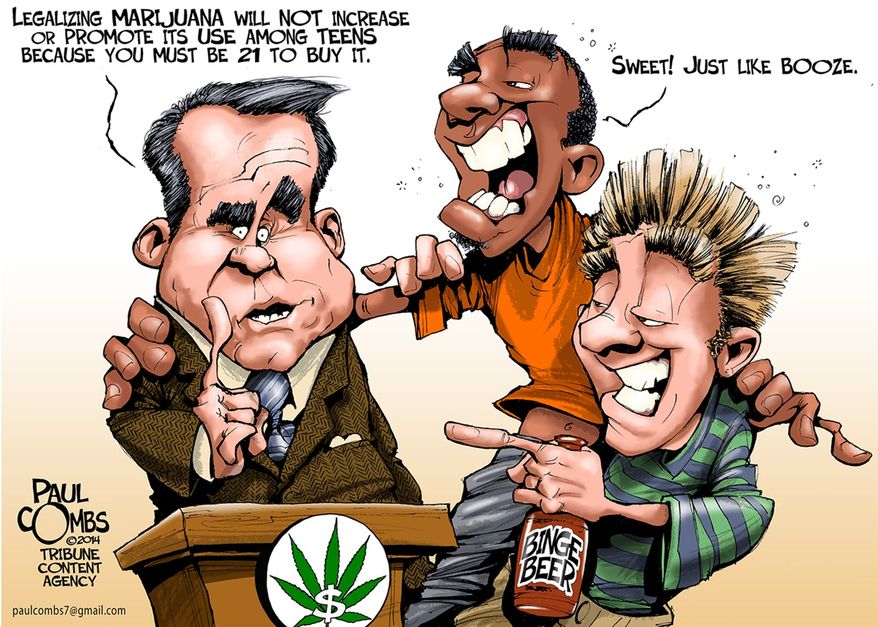
One of the main topics of discussion in the debate of marijuana legalization is the use of the drug by underage teens. Under current state marijuana laws in states that allow for the use of the drug, only someone 21 years or older can purchase it. However, this is met with controversy. For many years, the legal age of alcohol purchase has also been 21, yet studies show that this has not stopped many teens for using and abusing it. In Paul’s mind, legalizing the drug and allowing states to do so will only increase its use by underage teens. In effect, what he is arguing for is that the federal government should have the right to regulate its citizens behavior on morale issues. Basically stating that in some instances the federal government should protect its citizens from themselves. His argument mainly states that people although may want the choice of whether not they do something, but it is in the best interest of the people for the choice to be taken away by the government.
Why Did it Become Illegal?
It seems reasonable for anyone to ask the question, why did it even become illegal in the first place? In his article, On This Date: FDR Made Marijuana Illegal 81 Years Ago, Eric Revell discusses how and why the drug became illegal in the first place. He uses sources such as the Federal Bureau of Narcotics to explain how this drug became caught up in a war between the United States government and drug use. Using statistics about national drug use, he gives a compelling argument for the need to regulate drug use. Citing the high number of crimes committed by those under the influence of drugs. In addition to this, he cites the astounding number of individuals who were arrested or cited for violating marijuana laws in 2014. At 700,000 cases, he provides a reasonable explanation to why the war on drugs became and still is so prominent in the United States.
The use of facts and premier sources of information gives his argument more weight. His use of logos is powerful and cannot be ignored. There is only a slight bias in his article as the question of why marijuana use is so bad is never mentioned within the article. He does however discuss the use of the law to focus on minorities in particular and outlines this bias. Even so, his argument for the need of government to regulate the use of the drug is apparent and backed up through facts.
The implications of this article again suggest that it is the right of the federal government to regulate its citizens choices. Specifically using the staggering statistic about the number of drug arrests and citations for violation of marijuana law. He shows that citizens are not able to make what is deemed as the preferable behavior of not using drugs even when the it is illegal. This provides basis for showing that there is a necessity for the government to save the people from themselves, as the number of users would most likely increase if it were to be made legal by the states.
People Above All

As states have already begun to construct and pass their own marijuana laws, the majority of Americans are standing behind their states. In an article entitled, Who Should Regulate Marijuana? Most Say States Over the Federal Government, Joanna Piacenza lays out facts about Americans attitudes over who should have the right to regulate the drug. Using national polls, she shows that about 56% of US adults believe that states should have the right to decide, while only 26% believe that the federal government should have the right to decide. She gives a convincing and seemingly unbias update on the current attitudes towards the legalization of marijuana using facts and quotes from senators and experts in the field. This push for states rights over federal shows that the people want to have more influence on the decision and do not want things that fall into the category of morality to be run by big government.
Next, in the article from Safe Access Now, an update on the federal and states laws over marijuana legalization are given. The article goes over the new and old court cases with their decision and explain how they are slowly giving more and more power to the states to handle the issue. It talks about how government agencies are dealing with the tension between the law of the federal government and the states that have legalized the drug. The article does very well to put aside personal biases and outline only the facts from court cases. In addition to this, since it is just a summary of the court cases and the findings of them, there is a large amount of logos that goes into this article. This article allows for a deeper look into how the people are putting the power in their own hands. No longer are they just waiting for the federal government to make a decision, they go through local and state government, of which they have a much bigger impact on, to get the laws passed in order for the law to represent their ideals.
Not only this, but the people are finally taking action. This fact in itself expresses how strongly the individuals on this side are. For them to fight using a legal avenue to pursue their beliefs, it shows that this is not just a issue that can be put aside, but rather a fight for the right to control their own lives separate from the supervision of the federal government.
References:
https://www.safeaccessnow.org/federal_marijuana_law
https://www.countable.us/articles/849-date-fdr-made-marijuana-illegal-81-years-ago
Pictures:
https://openclipart.org/detail/304147/group-of-people
 Cosner Rhetoric