
The debate on whether there should be more gun control polices in America extends past the idea of either getting rid of the right to carry arms or instead, loosening the laws on gun control. Overall, the share of Americans who say gun laws in the U.S. should be made stricter has increased from 52% in 2017 to 60% this year, according to a survey conducted in September. The rigorous topic of gun control has brought up many debates and questions. On whether or not there should be stricter laws, we outline the effectiveness of the background checking system, the qualifications that one has to purchase a gun, whether or not they are mentally ill or stable, the idea that gun control is politically motived by both sides, and the question of is guns the problem.
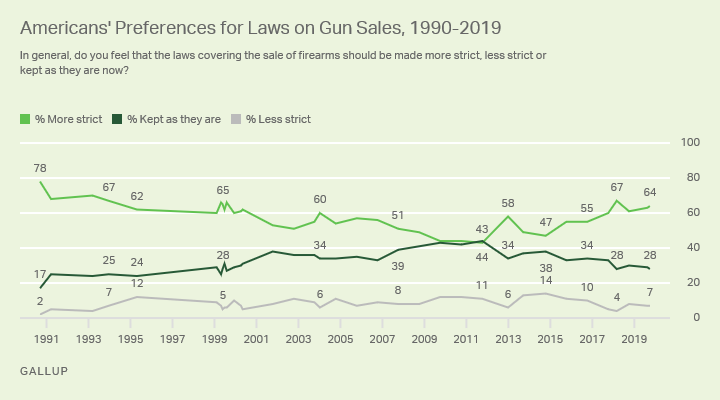
The data in a research done by Gallup’s annual Crime poll. Since 2015, however, support for stricter laws has registered at the majority level, peaking at 67% in March of last year after the Parkland, Florida, school shooting. The recent shootings over the past few years has sparked great interest in tightening up the laws on gun control.
State gun laws requiring universal background checks for all gun sales resulted in homicide rates 15 percent lower than states without such laws. The data results in a question of why don’t we change something? Policy makers have to take in account of laws such as the second amendment. While taking those restrictions into consideration, how come we still aren’t able to implement some sort of rule. Further proving this idea, “Laws prohibiting the possession of firearms by people who have been convicted of a violent crime were associated with an 18 percent reduction in homicide rates(Colarossi).” If there is firm evidence that stricter laws led to a decrease in homicide rates, something needs to be put in place, a law thats within the second amendment but also that can still aid to the decrease in rates of homicide and other statistics of gun violence. The aim of this article,(link in the blue sentence above), is to help readers understand that having some sort of policy can make a change. The target audience are the people who’s view is that people should be allowed guns, just more intensive background check policy’s.
On the other hand, we have people with viewpoints that we don’t need to have gun laws to stop the violence. In an article titled, “Why Gun Control is Not the Answer, and What We Can Do to Stop Gun Violence”, it provides various reason to support its title. Historically, “stricter gun regulations do not keep guns out of the hands of criminals(Perry).” The idea behind this quote said by Perry, is the idea that stricter gun laws keep guns away from people like myself: reasonable, mentally-stable, law-abiding people, who know how to safely use a firearm. People believe this to be true because there can be an argument made that anyone who kills someone, in a mass murder, can be deemed as not mentally stable, or mentally ill. Statistics will show that violent crime has been decreasing ever since Nixon and the Assault Weapons Ban.
The aim of this article is to shed light on the idea that its not so much of the gun laws, but people who have violent criminal intentions, or the mentally ill, not in the right state of mind people. If death is at the forefront of problems, activists for pro gun choice could bring up the idea that ” cancer kills fifty times that many people in the U.S. every year. So why hasn’t anybody proposed legislation to control cancer?(Perry)” Not to say that everyone who dies form gun violence isn’t tragic but knowing that theres something that’s fifty times more likely to kill me or a family member is quit alarming, almost pushing the idea of stricter gun control at the bottom of a ranking of deadly altercations.
Naysayers could also bring up the idea that we don’t know what classification mental illness falls under, for people who do take part in violence acts. What I mean by this is how do we define mental illness for someone who does commit a mass shooting? This would oppose the strong gun activists and cause a good conversation with policy makers on deciding laws.

In this political cartoon above you see two men, one who’s big and strapped with weapons while the other is smaller, sweating, and looks like he is scared. The man in the red has the words ” Gun Culture” written on his chest while it appears that he is holding the man with the words ” Call for U.S. Gun Control” on his chest, holding him hostage. This invokes the idea that the people who are pro gun and discourage laws, can be represented depending on the audience. One might say that the man in the red is bad ass and that not restricting guns can allow you to take control of a situation, or in this case, someone. Other view points can point to the opposite. The man who is being held at gun point, he is crying. He looks scared for his life. Someone can argue, not enforcing strict gun laws can give the freedom too many people who shouldn’t have guns in their possession.
The debate over gun control laws is heavily rooted in politics and the view points with different political parties. For the political parties, Republican and Democratic, “About seven-in-ten Republicans and Republican leaners favor allowing concealed carry in more places (72%) and allowing teachers and officials to carry guns in K-12 schools (69%); just 26% of Democrats and Democratic leaners favor each of these proposals“. This article from Pew Research Center they provide many different statistics but this stat about Republican and Democrats serves the purpose of outlining which party is for the gun control and the party who is opposed to the stricter laws. The author of the article, J. Baxter Oliphant, brings up a question that makes you question the legitimacy. Baxter writes, “And Republicans and Democrats have stark, fundamental differences on questions relating to the causes of gun violence – and even whether gun violence is a serious problem in the country”. He poses the question, is gun violence a serious problem in the country. While I was answering this question for myself it made me think, if gun violence isn’t a serious problem, then why would there be a need to write this entire article? Baxter fails to address how in every stat, if it’s for gun violence in the community or something about the strictness of gun laws, Republicans tend to lean always towards lesser laws and view their community’s safe from gun violence, more than Democrats.
A young man by the name of George Wang had a TedTalk on the topic of gun control. A statistic that struck me as a ready was that in 2012, 12,765 people were killed by firearms. Shockingly, 62% of those deaths were suicide. Whats your definition of gun violence? Is it violence against another person? When talking about gun control, George’s tone is almost a tone of questionability. Almost as if he was questioning the idea that guns maybe aren’t the problem and that there are other factors that play into the bigger picture, the picture that banning guns isn’t the way to go.
George brings up an idea in the TedTalk that if we ban guns, 100% of the guns used for violence will be obtained illegally. George suggests that even if we ban guns, people will find a way to secure a firearm and use it for no good. If we ban guns, people who don’t abide by the law already, will still be able to get guns, putting the lives of those who do follow law at risk. This is a very strong argument for the second amendment and for those who support pro gun that use self defense as a main argument. George brings up a good point in saying, ” This already exists. Drugs are banned but people still use them. You can’t even keep drugs out of prison. People always find a way to get what they want”. While the drug crisis is another topic for another day, they have some similarities when talking about making a certain thing illegal.
George seems a little bias towards the right side in the TedTalk. George makes remarks throughout the video, including one when he says, ” in order to ban all guns, we would need to confiscate every single one” and ” 127 million people follow the law and they”ll have to suffer for the one percent of people who make bad choices”. George, to me, seems to give us insight on where he stands on this issue as a person. George’s aim is to reach an audience of people who are for the right to bare arms. He almost sounds bias in my opinion with the tone and rhetoric used to address his audience.
Whether or not you support the sale and conceal of firearms, or are for the strictness of guns, there is no doubt a problem when guns get into the wrong hands of people. Republicans and Democrats have long argued the issue of gun reform.
Citations
Schaeffer, Katherine. “Share of Americans Who Favor Stricter Gun Laws Has Increased since 2017.” Pew Research Center, Pew Research Center, 30 May 2020, http://www.pewresearch.org/fact-tank/2019/10/16/share-of-americans-who-favor-stricter-gun-laws-has-increased-since-2017/.
McCarthy, Justin. “64% Of Americans Want Stricter Laws on Gun Sales.” Gallup.com, Gallup, 29 Oct. 2020, news.gallup.com/poll/268016/americans-stricter-laws-gun-sales.aspx.
Student, BU, et al. “State Gun Laws That Actually Reduce Gun Deaths.” Boston University, 6 Aug. 2019, http://www.bu.edu/articles/2019/state-gun-laws-that-reduce-gun-deaths/.
Perry, Clayton. “Why Gun Control Is Not the Answer, and What We Can Do to Stop Gun Violence.” Farmington Flyer, 2017, www2.umf.maine.edu/flyer/archives/2013-spring/issue-2-3-7-2013/why-gun-control-is-not-the-answer-and-what-we-can-do-to-stop-gun-violence/.
Oliphant, J. Baxter. “Where Republicans and Democrats Agree, Differ on Gun Policy.” Pew Research Center, Pew Research Center, 28 Aug. 2020, http://www.pewresearch.org/fact-tank/2017/06/23/bipartisan-support-for-some-gun-proposals-stark-partisan-divisions-on-many-others/.
Wang , George, director. Are Guns Really the Problem , 2017, http://www.youtube.com/watch?v=dR1doHTn8Ek.
 Cosner Rhetoric