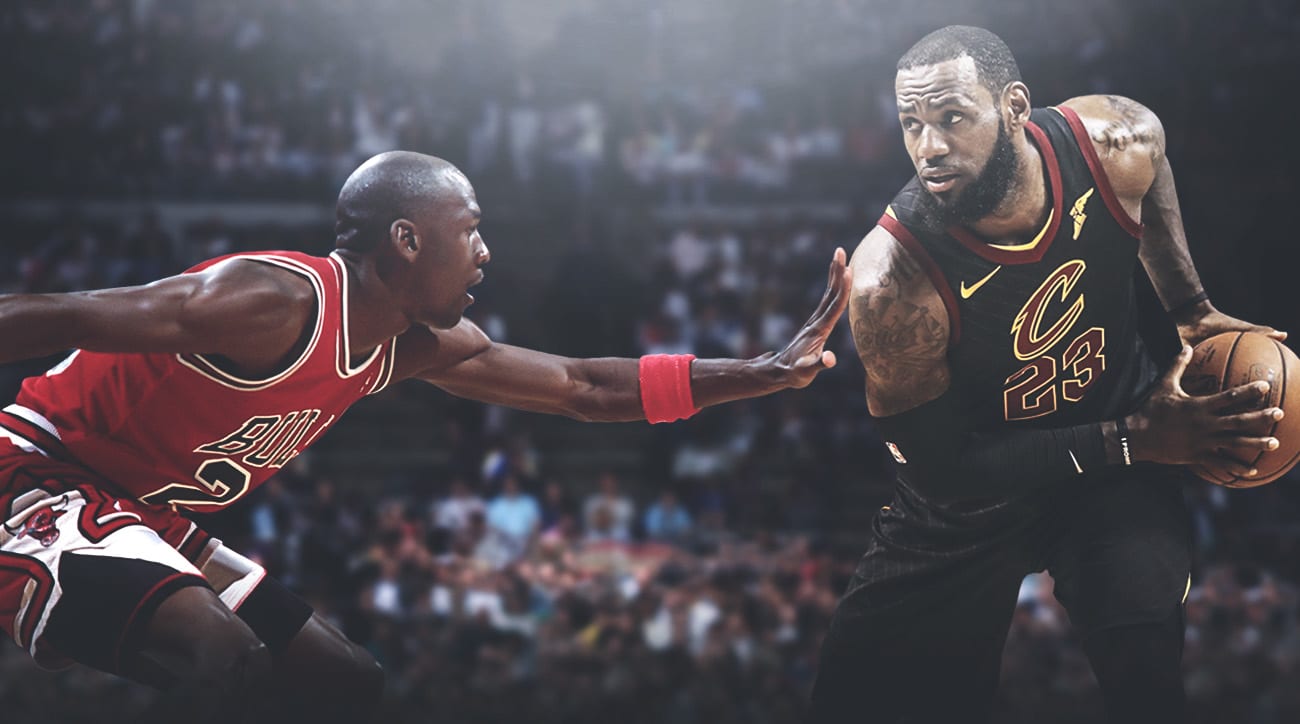
The debate on who the greatest basketball player of all time is, also known as the “GOAT” debate, is up there for one of the most discussed topics related to basketball. It seems as if no other sport emphasizes who the greatest player is as much as basketball does. Many people believe it is Michael Jordan, others think it is Lebron James, and there are numerous other basketball players that people make a case for being the GOAT. Whether it is the number of championships, individual statistics, overall dominance, the player’s legacy, or even personal bias, everyone has their rationale for who they believe the GOAT is. The numerous reasons that people use and the fact that we lack one definable set of qualifications makes picking one GOAT nearly impossible. The complexity of the GOAT discussion allows it to be relevant to more than just basketball fans. If we can determine the rationale through which we qualify someone to be the greatest of all time in a debate as intricate as the GOAT debate, then it will be possible to determine who the greatest is in all other sports or any type of competition. This leads us to the paramount question of the debate, what makes someone great and can we accurately name one person as the GOAT?
What Does it Take to be Considered in the GOAT Discussion?
The GOAT discussion is almost always a debate between Michael Jordan and Lebron James. The argument itself has occurred countless times, which means numerous cases have been made in favor of each athlete. I would guess that I’ve been in close to 100 GOAT debates myself and I’m sure any big fan of basketball can say the same. However, the majority of these debates end up turning into bickering and shouting matches. The sheer number of arguments is insignificant compared to the value that a quality argument holds.
According to Nick Jungfer, the lead writer for Basketball Forever, the aspect of Lebron’s career that qualifies him to be the GOAT is his longevity. In his article, “The Parts of the Michael Jordan-Lebron James GOAT Debate That Actually Matters”, Jungfer points out that Jordan’s subpar 15th season was his last and in Lebron’s 15th season, he led a rather “shambolic” Cavaliers team to his 8th consecutive NBA Finals appearance. Even though this article suggests that longer careers are better than shorter ones, Jungfer’s longevity argument isn’t highlighting how Lebron has played for many seasons, but rather that he has sustained his dominance for this long. It’s easy to assume that Jungfer chose this argument because he is impressed that Lebron has been the face of the league for almost two decades or because Lebron still plays at such a high level at 35 years old. Instead, by saying that “Lebron has been playing at an elite level for an inconceivably long time”, Jungfer is stressing how what Lebron is doing at this stage of his career is uncharted territory for any athlete. Even though this text accentuates Lebron’s unmatched durability, that alone doesn’t make Lebron the GOAT. Lebron’s unprecedented sustained dominance and the fact that no one has ever done what Lebron is currently doing permits Jungfer to label Lebron as the greatest. Nonetheless, regarding the phrase quality over quantity, some would argue that Lebron’s longevity isn’t enough to dethrone Jordan of his GOAT title.
That is why Jordan is the greatest ever: they all lost and he didn’t.
Zachmo Marsupalami
Zachmo Marsupalami, a sportswriter for Bleacher Report, writes an article titled “Michael Jordan: Why He’s a 6-Time Finals MVP, 6-6 Champion and G.O.A.T.“, that argues in favor of Jordan being the GOAT strictly based on Championships. Marsupalami considers losing as detrimental to an athlete’s claim to the GOAT title. He does this by listing out the few most common athletes that are considered in the GOAT debate and then discrediting them by telling how each one of them has lost in the Finals. Winning 6 championships is a very impressive achievement, but that’s not why Marsupalami is pro-Jordan. If the number of championships someone had became the metric we use to determine the GOAT, then it would undoubtedly be Bill Russell, who has 11 championship rings. Marsupalami considers Jordan to be the GOAT because Jordan never lost in a Finals series and he never let any of those series go to a game 7. It’s not about how well an athlete performs regularly for Marsupalami, it’s about being the best when it truly matters. The success of a team in a specific year is measured by their record, which is exactly how the author measures Jordan’s greatness. The ability to dominate anyone he competed against and repeatedly succeed at the most crucial moments is how Marsupalami justifies naming Jordan as the GOAT.

Is Bias an Issue in the GOAT Debate?
In the article, “Recency Bias and Its Footing in the NBA GOAT Debate” by Alex Brady, a bias that individuals unconsciously carry is revealed. Brady explains this issue by using the term recency bias. Recency bias can be defined as a bias that favors recent events over historical ones. Brady stresses the significance of the recency bias with regards to this argument because he claims that the time period an individual grew up would affect their opinion on the GOAT discussion.
You could attribute it to favoritism, yes, but I believe the greater problem is the lack of knowledge of the past.
Alex Brady
Since we are all humans and are subject to our own psychological prejudices, Brady relocates the blame from our own biases to a lack of knowledge of the past. This claim is very logical but rarely talked about. If someone grew up in the ’90s, which is considered to be the “Jordan Era” of the NBA, there is a way higher probability that they will believe Michael Jordan is the GOAT. The same is true for people that grew up in the last 15 years watching Lebron and for people that grew up watching Magic Johnson and Larry Bird compete in classic Boston Celtics vs. L.A. Lakers matchups. Watching a particular athlete and being able to witness first hand what makes them great, significantly affects opinions on the GOAT debate.
Realistically, a person sides with the athlete with whom they have had the most exposure. This can be through watching that athlete play in the present or by hearing stories from their parents or someone older than them about what it was like to watch a specific athlete from the past play. The term recency bias works well for people that have grown up more recently and are too stubborn to consider past players to be as good as current players. Nevertheless, in the case of someone refusing to consider a current player to be better than the player they idolized growing up and the general GOAT debate, the term familiarity bias better encompasses the discussion as a whole. Favoritism and emotions play a strong role in this debate, which is why someone rarely switches who they think the GOAT is. For example, people who grew up in Jordan’s Era thought that Jordan was the GOAT then and will always think that. It could be due to nostalgia or because they don’t want to believe they’re wrong, but that is why it would be extremely rare for someone to switch their GOAT from Jordan to Lebron. This bias can be problematic when applied to more serious matters. Especially right now, during the presidential election season, self-reflecting and detecting potential biases of any kind in our opinions is more important than ever.

Should We Even Try To Determine One GOAT?
Kobe Bryant, one of the most inspirational and admired basketball players of all time, claims that we need to stop comparing Jordan and Lebron so that we can fully appreciate both. Kobe played in the NBA for 20 seasons and is remembered for his work ethic and competitive nature after tragically passing away earlier this year. After years of studying film and successfully competing at the highest level of basketball, Kobe understood what made a basketball player great more than anyone. You would think that because of how competitive Kobe was and because he worked his whole life to become the GOAT himself, that he would be eager to determine the true GOAT. However, this is not the case and the complete opposite is true. As seen by his tweet from May 27, 2018, Kobe thought that it is not possible to determine the GOAT and that the debate can actually be damaging. When he said, “we can enjoy one without tearing down one”, Kobe was expressing that we do not need to think Lebron or Jordan is the greatest to fully appreciate them. The nature of the GOAT debate and any other time we compare multiple things is while you are supporting one side, you are bringing the other side down. Kobe wrote this tweet because he doesn’t think the GOAT debate is worth the expense of not fully appreciating one of the athletes. Understanding and applying this idea can be very beneficial because it warns against being overcritical and highlights the importance of cherishing the things that we take for granted in life.

The Endgame
The key difference in the source materials is not what they believe, but why they believe it. Like many popular debates, one well researched, well organized, and well-presented argument will likely still have bias and won’t affect the argument as a whole. Rather, understanding the motive behind why people take certain sides on a debate and using that to form a stance is a better route. This method is not only beneficial for the GOAT debate, it is very valuable when developing an opinion on significant matters.
Works Cited
Brady, Alex. “Recency Bias and Its Footing in the NBA GOAT Debate.” The Georgetown Voice, 24 Oct. 2020, georgetownvoice.com/2020/10/24/recency-bias-nba-goat/.
Bryant, Kobe. “We Can Enjoy One without Tearing down One. I Love What He’s Doing. Don’t Debate What Can’t Be Definitively Won by Anyone #enjoymy5 #enjoymj6 #Enjoylbjquest.” Twitter, Twitter, 28 May 2018, twitter.com/kobebryant/status/1000943668071514112?ref_src=twsrc%5Etfw%7Ctwcamp%5Etweetembed%7Ctwterm%5E1000943668071514112%7Ctwgr%5Eshare_3.
Jungfer, Nick. “The Parts Of The Michael Jordan-LeBron James GOAT Debate That Actually Matter.” Basketball Forever, 7 Mar. 2019, basketballforever.com/2019/03/07/the-key-points-of-difference-in-the-michael-jordan-lebron-james-goat-debate.
Marsupalami, Zachmo. “Michael Jordan: Why He’s a 6-Time Finals MVP, 6-for-6 Champion and G.O.A.T.” Bleacher Report, Bleacher Report, 3 Oct. 2017, bleacherreport.com/articles/637207-why-michael-jordan-is-a-six-time-finals-mvp-and-six-for-six-champion-and-goat.
 Cosner Rhetoric