
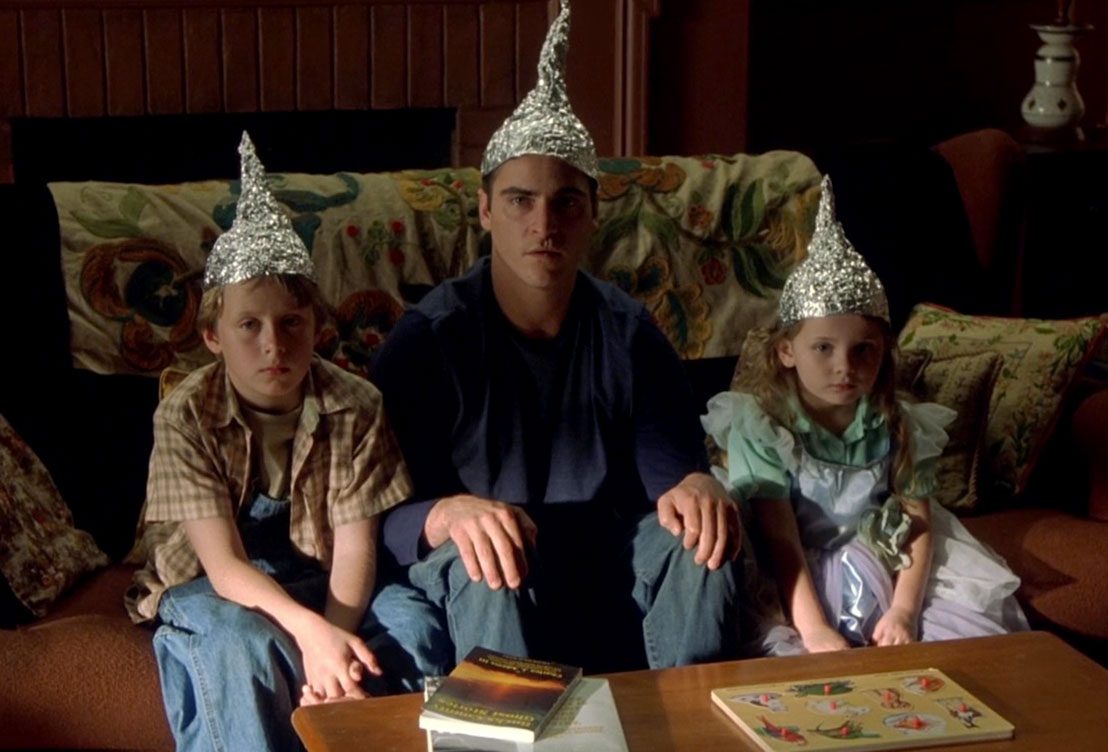
The Craziness in Us All?

Signs, 2002 dir. M. Night Shyamalan

Absolute Absurdity

The word “conspiracy” has a few meanings depending on how it’s used; likewise, it also has a few different connotations. It can be a verb used to describe joining a secret agreement to act in a hurtful or unlawful manner. It can also be used to describe a secret arrangement or plot. Both aforementioned definitions can generally be ascribed connotations of treachery, or mystery. Its final use is as a conspiracy theory, which is defined as the rejection of standard explanations in place of a belief that it was instead the result of a covert plot. As a study titled, “Stigmatized beliefs: Conspiracy theories, anticipated negative evaluation of the self, and fear of social exclusion” found, a social stigma is generally attached to conspiracy theories. While the use of the term conspiracy can be traced back to the earliest centuries of recorded history, it seems that even today the discourse surrounding conspiracies sees no end; ranging from the most skeptical minds to the most suspecting.

The All-Knowing-Knower of Nothing

In efforts to explain why some minds seem to reject the standard story, researchers have conducted various studies to explain what type of behavior, and what type of personalities tends to believe in conspiracy theories. One such journal by Hart and Graether, in 2018 finds that not only does it take a certain type of person to believe in conspiracy theories, the “distinct cognitive tendencies” displayed by such individuals can be used to predict whether or not they are likely to believe in such things. The research found that the most reliable indicator of a conspiracy believer was what they refer to as a constellation of traits known as “schizotypy”; which in short, is a theoretical concept in psychology referring to personality characteristics varying from normal dissociative, imaginative states and ranging all the way to extreme states of mind related to psychosis. These individuals, according to their research, differ in their pattern recognition tendencies in that they generally seek meaning or motive where there is none. While their research may look like more of an insult than anything, Hart adds that their research is intent to further the understanding of why some people are more attracted to conspiracies than others, and does not address strictly whether or not they are true.

Of course, the discourse surrounding conspiracies is not about whether or not they are true, rather it is about how often are they true. However the inherent flaw of conspiracy theories is akin to the fact that anyone can write a book, or draw a picture. In his essay Knitting Socks for the Beast: On Conspiracy, Jonathan Lethem compares conspiracies to a knitted sweater. The sweater relies on our hands and minds to create it. It is not real if not for our belief in them. And like a sweater, they begin to unravel. Beyond the outright limitless theories that “beg to be denied”, Lethem in the end concedes that society needs the paranoiacs and detectives in a balanced proportion, for without them society could be left in the dark.

A Two-Way Street

Not to say that there perhaps isn’t also an inherent flaw in the way conspiracies are viewed. That is, to say that to label anything a conspiracy is to discredit it, says David Coady who cites Sir Karl Popper as the man who gave conspiracy theories a bad rap. So bad is the view in fact, that Coady compares it to the label of heretics in the middle ages. This has the effect of discrediting an assertion merely because it implies conspiring particularly by an institution or of those in power. After all, a conspiracy theory is just that, a theory. This automatic assumption of falsehood given to conspiracies, Coady says, is just as much of a fallacy as those who irrationally dismiss them. In spite of the universal harm Coady says mainstream science positively imposes who generally concludes about conspiracy theorists in the words of a philosopher, “there is something wrong with how he thinks” (Cassam, 2015), people do conspire; they lie, and plot, some of us more than others.

A Silver Lining

After all some conspiracies turn out to be true: big tobacco knew cigarettes caused cancer for years, the government did poison alcohol during the prohibition, the CIA did get involved in a spot of drug trafficking, the CIA also did kidnap and conducted mind control experiments on people, the government was about to carry out terrorist attacks on its own people to justify war (only to be stopped by JFK himself), Watergate did happen, the government does spy on you.

So, when are they true? When are the biggest names in conspiracies actually right? Arguably the biggest name today, Alex Jones, has been the center of many controversial discourse over the years. To many, to describe anything Alex says as crazy is an absolute understatement. However some decide to look past the sort of superficial image that Alex has and instead look objectively at the things he says. Recently, Joe Rogan was one of these people. In his podcast, episode 1255 he had Alex on his show for the second time. In the podcast, which was so dense that Joe had to break out his “100% tobacco” to continue, Alex discusses everything from human-pig hybrids to interdimensional beings. Joe takes a stance that most would find reasonable, he surmises that Alex may use hyperbole but does not outright lie or say things that are unable to be fact checked. Of course, not everything Alex put on the table can be fact checked, but what can?

For starters, animal-human hybrids have been found to be completely viable and significant progress has been made. Possibly not in “man-bear-pig” sort of way (at least not yet) Alex insinuates in the podcast, scientists have however absolutely accomplished the feat of introducing human cells into non-human embryos.  These have all sorts of promise for the prolonging and repair of human bodies.

As for inter-dimensional beings, of course there is no proof that they are real. However, psychedelic users (more than LSD/acid) have long reported complex hallucinations along with reporting receiving information. Of course, they have also reported sentient beings that appear to even interact with the user. This is all based on the theory that certain psychedelics allow the user to open their eyes to an alternate universe. While the closest thing we have to evidence that government agents have used psychedelics to contact inter-dimensional beings is the CIA research project MK ULTRA, there has been research conducted with the goal of prolonging certain psychedelic experiences.

Continuing on the topic of MK ULTRA, the CIA’s at times illegal experiments into mind-control, there have been numerous testimonials of MK-ULTRA survivors discussing child kidnappings and organ trafficking, abuse, satanic ritualism, and here’s a kicker: child sacrifice running rampant in the military. Also terrifying is the recent research into 5G technology and its potential (and therefore potential to be weaponized) to affect the mind.

Perhaps most seemingly fictional is Alex’s constant references and claims regarding ESP and parapsychology. Which surprisingly has been the topic of interest to more than just paranoiacs and tarot card readers. One such institute was actually the CIA-sponsored Stanford research institute who speak of reported successful experiments in ESP, specifically in remote viewing.

Furthermore, it was no secret, at least to the CIA that the USSR also looked heavily into the subject. Who along with the CIA speak of reportedly successful experiments in (get this), psychokinesis. In one experiment, a woman was able to completely separate an isolated yolk from an egg.

Conclusions

Perhaps conspiracies get a little worse of a rap than it deserves, or maybe the topic deserves just as much skepticism as it gets today. Perhaps the truth is like the saying goes, lying somewhere in the middle. Maybe those who entertain them get a little more flak than they deserve; people like, dare I say, Alex Jones might get worse of a name than he deserves. Of course we must entertain the idea completely opposite of the skeptic. Maybe it is what the superhero and villain in all of us would hope, as J. B. S. Haldane puts it, “The universe is not only stranger than we imagine, it is stranger than we can imagine”.

Works Cited:

Blakemore, Erin. “Human-Pig Hybrid Created in the Lab-Here Are the Facts.” National Geographic, National Geographic Society, 26 Jan. 2017, news.nationalgeographic.com/2017/01/human-pig-hybrid-embryo-chimera-organs-health-science/.

Cassam, Quassim. “The Intellectual Character of Conspiracy Theorists – Quassim Cassam | Aeon Essays.” Aeon, Aeon, 17 Apr. 2019, aeon.co/essays/the-intellectual-character-of-conspiracy-theorists.

Coady, David. “In Defence of Conspiracy Theories (and Why the Term Is a Misnomer).” The Conversation, 8 Nov. 2018, theconversation.com/in-defence-of-conspiracy-theories-and-why-the-term-is-a-misnomer-101678.

“Commission Dossier.” Committee to Support the ITNJ, itnjcommittee.org/why-the-itnj/commission-dossier/.

Fields, R. Douglas. “Mind Control by Cell Phone.” Scientific American, 7 May 2008, http://www.scientificamerican.com/article/mind-control-by-cell/.

Gallimore, Andrew R., and Rick J. Strassman. “A Model for the Application of Target-Controlled Intravenous Infusion for a Prolonged Immersive DMT Psychedelic Experience.” Frontiers, Frontiers, 30 June 2016, http://www.frontiersin.org/articles/10.3389/fphar.2016.00211/full.

Hart, Joshua, and Molly Graether. “Who Believes in Conspiracies? New Research Offers a Theory.” ScienceDaily, ScienceDaily, 25 Sept. 2018, http://www.sciencedaily.com/releases/2018/09/180925075108.htm.

LaMothie, John D. “CONTROLLED OFFENSIVE BEHAVIOR.” Cia.gov, http://www.cia.gov/library/readingroom/docs/CIA-RDP96-00787R000100120001-9.pdf.

Lantian, Anthony, et al. “Stigmatized Beliefs: Conspiracy Theories, Anticipated Negative Evaluation of the Self, and Fear of Social Exclusion.” European Journal of Social Psychology, John Wiley & Sons, Ltd, 5 June 2018, onlinelibrary.wiley.com/doi/10.1002/ejsp.2498.

Lethem, Jonathan. “Knitting Socks for the Beast: On Conspiracy.” The Paris Review, 5 Nov. 2018, http://www.theparisreview.org/blog/2018/11/05/knitting-socks-for-the-beast-on-conspiracy/.

“NEWS REPORT ON RESEARCH PERFORMED BY STANFORD RESEARCH INSTITUTE ON ABILITY TO VIEW LOCATIONS REMOTELY.” Cia.gov, http://www.cia.gov/library/readingroom/docs/CIA-RDP96-00787R000200080011-2.pdf.

Rogan, Joe, and Alex Jones. “Joe Rogan Experience #1255 – Alex Jones Returns!” YouTube, YouTube, 27 Feb. 2019, http://www.youtube.com/watch?v=-5yh2HcIlkU.

Male-focused feminism and “Toxic” masculinity

Buzzfeed- 18 photos of men crying that challenge gender norms (http://www.buzzfeed.com/lauragallant/18-photos-of-men-crying-that-challenge-gender-norms)

Now, more than ever, the floor is open to discussion on social equity. Whether it be #Blacklivesmatter, #Metoo, or #Loveislove, people are speaking up against the oppression that has suppressed the minority figures of the populous for so many years. These people have spoken up about their short comings society provides them, but as the topics are further explored, heads are being turned toward the current head of the table to listen, support, and analyze the struggles our society still holds. In the essays, “Roles of Men with Feminism and Feminist Theory” by Brian Klocke, with supporting evidence from Alison Jagger, an author, professor, and pioneer in introducing feminism to philosophy, “Teaching Men to Be Emotionally Honest,” by Andrew Reiner, a published author and writing and cultural studies professor at Towson University, and “Gender Differences in the Relationship Between Empathy and Forgiveness” by Loren Toussaint, professor of psychology at Luther College, and Jon R. Webb, professor of psychology at East Tennessee State University, the topic of men focused feminism, and the issues therein, to aid in feminist theory and equity, is thoroughly explored.  To accompany these factual based, or scholarly sources, on a similar topic, a TED Talk by Justin Baldoni, a series actor and often type casted as “manly” shares his opinion on “Why I’m done trying to be ‘man enough’.” These sources have catered toward the idea that in order to develop a greater societal gender equity, we must first build a more empathetic and humanist society that is aided by male-focused feminism. 

“Broken” Masculinity

 We were told since we were children that bullies derive from hidden insecurities. Bullying against differences, bullying against minorities, bullies taking their hidden insecurities and manifesting the accumulated shame into projected anger—especially in men. “Sexism negatively impacts men by forcing them into a hyper-masculinity which engages high-risk behavior and limits their emotional expression as full human beings. “ (Klocke, Nomas.org) To the women in the room, this is not an allowance for men to create these negative, stereotypical spaces, to the men, it is a call out. Sexism can also be a man suppressing another man. Understand that you are expected to withstand these hyper-masculine values. Your awareness is crucial to its antidote.

This high-risk behavior and limitation of emotional expression inhibits men from exploring their true feelings and allowing for a single outlet—anger. It takes teaching to counteract thousands of years of tradition to “Man-up”. “Despite the emergence of the metrosexual and an increase in stay-at-home dads, tough-guy stereotypes die hard. As men continue to fall behind women in college, while outpacing them four to one in the suicide rate, some colleges are waking up to the fact that men may need to be taught to think beyond their own stereotypes.” (Reiner 590) For it is men that feel the most, and society conditions them otherwise.

 In a National Institute of Healthy Study, study done by Toussaint and Webb, they found that “Many boys, especially early and middle adolescents, develop deep, meaningful friendships, easily rivaling girls in their emotional honesty and intimacy. But we socialize this vulnerability out of them” (Toussaint and Webb, Ncbi.gov).In so being, we must reteach what men so innately feel.  Similarly in Baldoni’s TED Talk, he goes on to say, Another man holding him accountable to create a safe space for him to feel and the transformation was instant” (Baldoni, Ted.com). The men exploring these topics in their writing and speech are bringing awareness to this to create a solid foundation for support. This foundation will be the catalyst to support the women and other minorities suppressed. Love yourself to love another.

The Male Feminist

“He can do it” (hoog.li)

So why should men care? The human experience. Yes, it seems like a rather mundane supporter, but the empathy to another’s experience is to greater understand your own. The relationship of healthier emotional expression in men and greater empathy for other is seemingly irrelevant. However, Klocke and Baldoni continually explore the correlation. Klocke frequently addresses this topic in his short essay, “Although I believe that men can be pro-feminist and anti-sexist, I do not believe we can be feminists in the strictest sense of the word in today’s society. Men, in this patriarchal system, cannot remove themselves from their power and privilege in relation to women. To be a feminist one must be a member of the targeted group (i.e a woman) not only as a matter of classification but as having one’s directly-lived experience inform one’s theory and praxis “ (Klocke, Nomas.com). Use your greater heard voice and your newfound emotional expression to be the assisting and understanding voice to another. However, one must tread carefully as to not negate another’s experience and be correctly informed. Share feelings and understanding of existing human experience. Truly listen.

Accidental “Meninism”

The line is fine within the patriarchy, men’s activism cannot be the main focus, but rather the aid from which fuels to feminist liberty. This freedom from the success of the feminist theory will give men the social freedom and women the proper equity the human experience is entitled to. “The men’s movement should not be separate from the women’s movement but instead become a segment under the larger feminist movement. In this way men would not be taking center stage in yet another part of women’s lives allowing a slightly more subtle form of domination to continue” (Klocke, Nomas.com). Klocke makes a point to tell men not to silence the voices of those they are standing up for. Feminism is not their fight to win, but rather theirs to aid. Baldoni similarly states in an instance he experienced with his wife, “I would just cut her off mid-sentence and finish her thought for her. It’s awful. The worst part was I was completely unaware when I was doing it. Here I am, doing my part, trying to be a feminist, amplifying the voices of women around the world and yet at home, I am using my louder voice to silence the woman I love the most”(Baldoni, Ted.com).

So, let the women be the Rocky in their own stories. The authors of these texts were created to draw attention to a seemingly unending issue.  To find a possible resolution. Men, “Man-up” and listen to support the strong women in your lives. Do not let your bigger voice silence hers. Silence the voices that are not letting her truly speak.  Let women live in a world where they do not have to stand up and say #Metoo, just so that they seem believable. Teach the boys to have love for themselves and others and create the empathy they so innately craved in their youth. The human experience to care for yourself and others. Listen. Protect. Love.

Works Cited

Baldoni, Justin. “Why I’m done trying to be ‘man enough’.” Ted Talks, (www.ted.com/talks/justin_baldoni_why_i_m_done_trying_to_be_man_enough), 2017.

Klocke, Brian. “Roles of Men with Feminism and Feminist Theory.” National Organization for Men Against Sexism, (www.nomas.org/roles-of-men-with-feminism-and-feminist-theory/), 2013.

Reiner, Andrew. “Teaching Men to Be Emotionally Honest.” They Say/ I say, edited by Birkenstein, Cathy, Durst, Russel, Graff, Gerald, W.W. Norton & Company, pp. 589-595.

Toussaint, Loren and Webb, Jon R. “Gender Differences in the Relationship Between Empathy and Forgiveness.” The National Center for Biotechnology Information, (doi: 10.3200/SOCP.145.6.673-686), 2005, pp. 673-686.  

Gun control in America. How much freedom do you really want?

Evan Clauss


“A well regulated militia being necessary to the security of a free state, the right of the people to keep and bear arms shall not be infringed”

           In America the debate about gun control seems very clear.  One side wants gun regulation which includes background checks, age limits, and bans on certain guns.  The other side wants gun legislation to remain largely unchanged or even weakened. To the casual observer in this debate it would seem like a very clear “cookie cutter” debate.  This is not the case however. The debate on guns in America and regulation on guns goes much deeper than simply one side wants more control and one side wants less. The debate on guns goes back to the founding of our country and what rights mean the most to our citizens and which historical values remain important to Americans.  This debate is a battle of America’s most prominent values including small government vs big government, authoritarian vs individualists, and the rights of an individual vs the rights of a group.

Photo by Matthis Volquardsen on Pexels.com

The Background

           Typically, liberals, or those who lean left of center, wish to ban guns or increase regulations.  Many left leaning states, counties, or towns have no problem enforcing bans on certain guns such as the AR-15 or certain handguns they have deemed “unfit for civilian ownership”.  Under the guise of “keeping guns off the streets” they have successfully installed, what many would consider, and authoritarian government. This is why the debate about guns is such a hot button issue for many voters, gun regulation by definition means a stronger and more powerful central government.  Not to say that is a bad thing, but for many Americans small government and individual freedom is their “hill to die on”.

The Debate

Guns are in the news everyday.  It seems like once a week there’s a mass shooting.  The news people hear and read about gun rights certainly has an effect on what they view as an effective solution to the gun problem.  Typically people seek the news that they want to hear, and in the case of gun control that is no different. Most republicans or people that believe in less restrictive gun control will read a news source that agrees with them.  It goes the same way for Democrats or people who want more gun control. The news is just an echo chamber for your own beliefs but it is important to see what the underlying argument for or against gun control is. Both sides of this argument will use the appeals to try to sway people into believing they are correct and both sides are very effective at it.  Sources that call for more gun control use pathos masterfully  get their point across.


“without the weapons of mass murder, 50 New Zealand worshipers would still be alive; 17 Parkland, Fla., schoolchildren and staff members would still be alive; nine Charleston, S.C., churchgoers would still be alive; 11 Pittsburgh congregants would still be alive; 58 Las Vegas concert goers would still be alive; 26 Newtown, Conn., first graders and adults would”

Kristoff

 This style of reporting allows people who support gun control to “bury their head in the sand” and makes the case for banning guns even stronger. The “buzzwords” used by supporter of gun control also are used to inspire fear whether regardless of what the facts say. The tone used in this article paints gun owners as the bad guys. It’s impossible to convince someone that you should be able to own a “weapon of mass murder” and referring to certain guns as such is an attempt by the author to minimize the argument gun owners put forward.  Any argument for owning an AR-15 is unwinnable if your opponent views the gun as a “weapon of mass murder”.

In addition to labeling AR-15s weapons of mass murder, gun control supporters have another popular technique to try to rally support for their cause.  They paint gun owners with the same broad brush. While suggesting more gun control that many people oppose the writer of this piece said this:


What he said was perfectly reasonable. And it would seem that no reasonable person, regardless of their stance on firearms, would have issue with any of it”

Glanton

By suggesting that no reasonable person could oppose these gun control measures, the author is clearly saying people who do not want gun control are not reasonable. The author also makes the point that the ranks of gun control opposers have been filled with racists as well as bigots.  This holier than thou attitude allows those who support gun control to dismiss any argument made against gun control by being convinced that the person is unreasonable, racist or a bigot.

After reading or hearing any opinion on gun control it can be difficult to figure out exactly the underlying message of that piece as well as the previously unforeseen consequences of the suggested action.  The supporters of gun control want a bigger and more controlling government but they sell it by using pathos and other techniques to make it less obvious that they want to restrict individual freedom. Their use of pathos is the “sugar to make the medicine go down”.  Reading this article they call for several steps to reduce gun violence including, more background checks, a federal registry, red flag laws, laws that dictate how your gun is stored, and limiting the amount of guns someone can buy.  

Photo by Pixabay on Pexels.com

All of this is said to reduce gun violence, and it may, however the underlying theme is abandoning the rights and freedoms that this country was founded on for an updated model of freedom. All of these suggestions require more regulations, more laws, and the tradeoff to that is less freedom.  The supporters of gun control value the safety of the group more than they value the rights of individuals which is a fairly new idea in American politics. This piece is very subtle when it comes to talking about restricting rights because they are discussing guns. However when you apply what they are suggesting to another topic, such as automobiles, it becomes very clear.  Imagine if someone suggested regulating how you can store your car, how many cars you can buy, background checks for buying cars and so on. The true message of the piece is much easier to decipher when you apply it to something else.

From across the aisle there is the viewpoint of less gun control or no more changes.  The main themes of those articles are just as difficult to find but under closer examination they reveal themselves.  In this article the main ideas behind most gun control movements are dissected and discussed.  The writer uses the appeals to support his viewpoint.


“Banning all semi-automatic guns would endanger lives”

Lott

 The writer is using pathos to appeal to the emotions of the reader and supports it with data to form their argument.  This articles theme is more freedom. The writer does not want the government to have more power, he believes it already has enough.  This viewpoint runs parallel to the traditionalist “god given rights” viewpoint. This article is written by someone who values our historic rights and does not want to change them.  This seems to be the theme of most people who oppose gun control. They value individual freedom and less government more than they value what the gun control supporters typically call “the right to live” and a broad, powerful government.  

When combined the rhetoric of those who support gun control is overwhelmingly filled with name calling and heartbreaking appeals while the opponents of gun control stick mostly to facts and data.  All of this debate can be boiled down into one simple question, that’s prevalent throughout the entire discussion, that all of us should ask ourselves.

Do you want the government to tell you what to do?

Works Cited

Glanton, Dahleen. “Racism and the Gun Rights Movement: Too Close for Comfort.” Chicagotribune.com, 29 Jan. 2019, http://www.chicagotribune.com/news/columnists/glanton/ct-met-dahleen-glanton-guns-racism-20190128-story.html.

Kristof, Nicholas. “10 Modest Steps to Cut Gun Violence.” The New York Times, The New York Times, 24 May 2018, http://www.nytimes.com/2018/05/23/opinion/texas-shooting-guns.html?action=click&module=RelatedLinks&pgtype=Article.

Kristof, Nicholas. “New Zealand Shows the U.S. What Leadership Looks Like.” The New York Times, The New York Times, 20 Mar. 2019, http://www.nytimes.com/2019/03/20/opinion/new-zealand-gun-control.html?rref=collection/timestopic/Gun Control&action=click&contentCollection=timestopics&region=stream&module=stream_unit&version=latest&contentPlacement=9&pgtype=collection.

“March for Our Lives: Gun Control Ideas Sound Good, but Are Deeply Flawed and Won’t Save Lives.” Fox News, FOX News Network, http://www.foxnews.com/opinion/march-for-our-lives-gun-control-ideas-sound-good-but-are-deeply-flawed-and-wont-save-lives.

Bursting the Capitalistic Bubble of Identity

Individual Expression and Societal Structures of Manipulation: The Conversation Surrounding Contemporary Feminism and Masculinity

We must be swift as the coursing river

with all the force of a great typhoon

with all the strength of a raging fire

mysterious as the dark side of the moon

Be a man!

By emphasizing the “raging fire” of the more ‘masculine’ gender and the mysterious nature of male emotions, this song lyric from the Disney movie Mulan emphasizes the viewpoint that the shielding of one’s feminine characteristics such as emotions is an effective method of attaining success in any aspect of society.

Great Advice, Mulan! After all, the societal structures of capitalism effectively engulf an individual’s ability to express oneself and create two drastically different ‘bubbles’ of what it means to be a man and a woman. Therefore, in order to achieve society-defined success and overall well-being, one must obviously conceal all feminine or emotional aspects of oneself and “be a man” (Mulan).

Today’s capitalistic environment in the workforce discourages recognition of one’s personal life and emotional expression.

Although this issue seems, on the surface, to be that of the valid nature of femininity and masculinity, the larger conversation encompasses how the economic and social structures of capitalism encourage individuals to limit emotional expression in order to attain success and, ultimately by doing so, threaten their mental well-being. In this global conversation, there are various perspectives that disagree on the source of the state of the individual and whether the individual him or herself is directly involved in the unattractive state of their well-being. Furthermore, many perspectives emphasize emotional well-being and societal progress to an increase in the emotional intelligence and recognition of one’s feelings in both men and women.

SOURCE OF THE EMOTIONAL REPRESSION AND DEPRIVATION OF ONE’S WELL-BEING

I. Entangled in the Grasps of Societal Structures and Idea of Success

There is much debate as to whether the source of repressed individual identity and emotional success is the individual him or herself or the society that surrounds the individual. In the article “Why Women Still Can’t Have It All?” by Anne-Marie Slaughter, who “has taught at Princeton University and Harvard Law School and worked as the director of policy planning for the US State Department” the idea of economic and social structures of society being a barrier to individual success and a motivating factor of repressing individual emotional identity is emphasized (Slaughter 534). For example, Slaughter effectively furthers the claim of the capitalistic environment’s direct effect on an individual by emphasizing a personal realization of how being successful according to today’s economic and social standards and attaining well-being is dependent “almost entirely on what type of job [one has]” (539). It is evident that Slaughter regards the individual as powerless and largely directed by outside forces-such as the economic and social structures-to repress certain feminine or emotional characteristics in order to pursue greater success in any particular field.

Sheryl Sandberg contrasts Slaughter’s claim of society’s dramatic influence on an individual’s work-life balance by promoting the idea of self-action and internal balance.

II. Be a Man, Sis!

However, Slaughter’s view can be contrasted with that of Sheryl Sandberg, a Facebook Chief Operating Officer, who emphasizes in her TED talk that “when a woman starts thinking about having children, she doesn’t raise her hand anymore [and] she starts leaning back” (Slaughter 541). By portraying the relationship between the capitalistic market/work field and women, Slaughter displays Sandberg’s perspective that holds women accountable for their ultimate success and overall well-being. Furthermore, Slaughter emphasizes the dangers of being a woman, having emotions or feminine characteristics, and respecting time at home with loved ones in relation to its effects on an individual’s growth up the capitalistic ladder of success. Overall, there is much debate surrounding whether the decrease in emotional well-being and expression of one’s identity is due to the individual him or herself or instead due to the capitalistic economic and social structures of an individual’s surrounding that demand him or her to be emotionally insensitive and, ultimately, hurting overall well-being of the individual and progress of the society.

Gillette discourages and sheds light on the long-held tradition of using phrases like “boys will be boys” to condition men from a young age to be emotionally insensitive.

III. Rethinking the Definition of ‘Be a Man’

A glimpse of Sandberg’s perspective on how self-initiative can be linked to an individual’s success and improvement in mental well-being is evident in a recently produced short-film titled “We Believe: The Best Men Can Be” by Gillette: a popular brand of men’s razors on a global scale. For instance, Gillette effectively showcases the drastic difference between traditional views of how a man must act in a society versus the characteristics of emotional understanding and mutual respect (“We Believe: The Best Men Can Be”). Throughout the film, Gillette is voicing the claim that self-initiative and healthy emotional-awareness of oneself is an essential component of success and overall well-being of an individual and the surrounding community.

THE NEW GENDER-GAP AND FINDING BALANCE

I. What’s the Cost of Living in the Bubble: Unaware and Detached from Reality? Simple, Just Your Soul and Well-being.

According to Slaughter, there is a “new gender-gap” emerging that shows drastic differences in well-being among women and men. For instance, when displaying that balance between work and family is beneficial to the collective group of men and women, Slaughter cites from a Palliative care giver that almost every male patient “missed their children’s youth and their partner’s companionship” (Slaughter 547). Furthermore, Slaughter addresses individuals who identify themselves as feminists and emphasizes that “the pioneer generation of feminists walled off their personal lives from their professional personas to ensure that they could never be discriminated against for a lack of commitment to their work” (Slaughter 545). Slaughter effectively uses logos to portray the general ideology of modern feminists and the identity these women are forced to embody because of economic and social stressors from the capitalistic workforce. Overall, Slaughter believes that well-being and the “pursuit of happiness” is a common theme to both genders and the modern-day structure of society proves to be a roadblock in the path to attaining such success. For example, Slaughter believes that “women can ‘have it all at the same time’ but not today, not with the way America’s economy and society are currently structured” (Slaughter 538). By emphasizing the role of today’s workforce on an individual’s state of well-being, Slaughter states her claim that the genuine source of limited happiness and satisfaction, and unattainable success is the current system of capitalism.

Although some claim that the societal structures are to blame for the unbalance and emotional repression of individuals in the workforce, others believe that it is truly one’s own self that contributes to the state that individual is in.

II. Umm…Did You Read the Job Description Before Applying?

Slaughter’s idea of aspiring to achieve internal balance in the face of societal barriers is refuted by the ideas emphasized in Senior Editor Richard Dorment’s article “Why Men Still Can’t Have It All.” For instance, by stating that “if [one] doesn’t want a high-pressure, high-power, high-paying job that forces [one] to make unacceptable sacrifices in the rest of your life, don’t take the job,” Dorment depicts how the individual is truly responsible for their state of distress or limited emotional expression (Dorment 574). However, even though Dorment puts the pressure on individuals to create their ideal state of well-being, he does acknowledge the presence of economic and social structures that encourage emotional insensitivity and create two personas of the human population. Strong and emotional. Man and woman. Competent and incompetent. Dorment’s word choice (“forces”) artistically shows the direct and active role that the current capitalistic society plays in determining an individual’s emotional expression and, ultimately, overall success in any aspect of society.

TO BURST OR NOT TO BURST: OVERALL CONVERSATION OF THE DYNAMIC OF CAPITALISM & SELF-IDENTIFICATION

Conventional wisdom has it that organization is key, and there is global conversation surrounding whether human beings are organized into two compartments-isolated into two bubbles-when it comes to the economic and social realms of our capitalistic society. There are many perspectives that voice their claims on the genuine source of an individual’s emotional insensitivity and repression of one’s authentic identity in the aims of pursuing success as it is defined by the community one lives in. Beyond this, other perspectives emphasize the dramatic effect that the capitalistic mentality is having on the well-being of individuals and the widening emotional gender-gap in our community. Moreover, these diverse perspectives voice varying claims regarding the true definition of success: the pursuit of happiness versus the pursuit of achievement in one’s own industry. However, a majority of these perspectives have hinted at or evidently emphasized the existence of the two economically and socially defined characteristics that one must symmetrically align with to ensure success in the workforce.

As the sun rises every morning and propels us towards the future and as the many perspectives in this global discussion of capitalism’s effect on an individual’s quality and experience of life come to the surface, the community we live in will acquire a broad understanding of this issue and how it pertains to the emotional well-being and overall success of an individual, society as a whole, and generations to come.

Works Cited

Dorment, Richard. “Why Men Still Can’t Have It All.” They Say I say, edited by Gerald Graff, Cathy Birkenstein, and Russel Durst, W. W. Norton & Company, 2018, pp. 555-575.

Mulan. Directed by Barry Cook and Tony Bancroft. Walt Disney Feature Animations, 1998.

Sandberg, Sheryl. “Why We Have Too Few Women Leaders.” uploaded by TED: Ideas Worth Spreading, December 2010, https://www.ted.com/talks/sheryl_sandberg_why_we_have_too_few_women_leaders.

Slaughter, Anne-Marie. “Why Women Still Can’t Have It All.” They Say I say, edited by Gerald Graff, Cathy Birkenstein, and Russel Durst, W. W. Norton & Company, 2018, pp. 534-554.

“We Believe: The Best Men Can Be | Gillette (Short Film).” YouTube, uploaded by Gillette, 13 January 2019,https://www.youtube.com/watch?v=koPmuEyP3a0.

The Captain Marvel Controversy: What it says about Feminism and Representation Today

Promotional photo for Captain Marvel, Marvel Studios. From: Heroic Hollywood

One of the most polarizing topics in today’s world of social media and entertainment is that of feminism. Echos of this controversy are heard in discussion of comics, video games, TV shows and movies alike. As more films begin to dip their toes into the waters of female empowerment, there has been both expected and unexpected push-back. Most recently, the latest film in the Marvel Cinematic Universe, Captain Marvel, has sparked new fires within this debate.

A lot of the push-back for female-led films is made up of online keyboard warriors under the comfort of anonymity. Although the general rabble and misunderstandings do have a place in this conversation, the real discourse comes from those who have already more or less adopted a feminist worldview. These conversations take into account the nuance or lack thereof in the feminism of Captain Marvel, as well as how that feminism plays out in the real world. While some believe that Captain Marvel‘s feminism is resonant and powerful, ushering in a new type of female empowerment, others argue that Captain Marvel is not as ground-breaking as it is cracked up to be. As the world moves ever forward, humanity must continue to reevaluate the role of female empowerment and examine how and where it fits today.

The Feminism of Captain Marvel

Captain Marvel is undoubtedly a feminist movie. The very first official trailer for the film was praised for its clever word play showcasing the word “HER” fading into “A HERO.” A lot of noise has been made about the film as it is the first with a female lead in the Marvel Cinematic Universe. Coming after 20 previous films, many boast that it’s about damn time. Although there are many amazing female characters already present in the MCU, none of them have had their own solo origin story. Captain Marvel is paving the way for the next era of superhero movies, which will hopefully include more female-led films.

Eliana Dockterman’s article for Time magazine entitled “How Captain Marvel Breaks the Superhero Mold” praises Captain Marvel for its altered approach to the female superhero. While acknowledging Wonder Woman as the first largely praised successful film with such a hero, she points out that because of this it had to be approached carefully. Wonder Woman could not be too polarizing, one way or the other, and the result was a “distinctly feminine hero,” complete with skirt and heels, a male love interest, and ideologies and displays of peace that were “awe-inspiring, not frightening.” What Captain Marvel does differently is allow its hero to be messy and more flawed. The character’s costume shows no excess skin, very reminiscent of something her male counterparts would don, and her attitude and mentality is more in line with those counterparts as well. Carol is unapologetic in her strength and wit. Because of this Captain Marvel is allowed to have bigger character flaws, and come off as not immediately and universally likable. Captain Marvel shows its audience of young girls that they too don’t have to be universally likable.

Where some writers expressing similar viewpoints can feel like they do not acknowledge or give full credit to the female-led films that have come before Captain Marvel, Dockterman excellently and eloquently does just this while also explaining how important Captain Marvel is. Separating the films and explaining how each had their own unique struggles, in no way does Dockterman come across as dismissing previous films, and this really helps to strengthen her claim.

Actress Brie Larson with girls dressed as Captain Marvel

Gathering quotes from the writer of the Captain Marvel comics (from 2012 and onward) Kelly Sue DeConnick gains Dockterman ethos, providing evidence that this is what Captain Marvel the character is intended to be. Additionally the incredible pathos of another female hero for young girls, this one dressed as nonsexual as possible, is reflected everywhere across social media in others who share the sentiments of Dockterman. In her words, “Captain Marvel represents a break from those walking clichés. That’s crucial because girls and boys need more female role models onscreen.” Providing more representation on screen can help shape the industry of film and allow more female-led films to be made.

Internet Backlash Against Captain Marvel

What Dockterman’s article only touches on, Alex Abad-Santos fully analyzes in his article entitled “How Captain Marvel and Brie Larson Beat the Internet’s Sexist Trolls.” Writing for Vox, Abad-Santos brilliantly and succinctly synopses the online backlash that Captain Marvel received before its release.

Perhaps one of the most important insights of Abad-Santos’ is how this backlash has been experienced by other films before. Films like Star Wars: The Force Awakens and The Last Jedi, as well as the 2016 Ghostbusters reboot received similar backlash for their choice of more diverse casting. He states that “this kind of backlash consistently erupts when women and non-white characters are at the center of Marvel Studios superhero flicks or other cinematic franchises with long, less-diverse histories.” Abad-Santos claims that the coverage and handling of the Captain Marvel controversy has learned from these past discrepancies, and successfully guided the conversation more toward the film itself and its message.

The language used to describe those behind the backlash can be seen as demeaning, but every article in which the people that review bombed this movie are discussed refers to them as ‘sexist trolls,’ and other similar names. For the most part this is rightfully so. The only danger with reducing all of these people down to such labels, even when they may deserve it, is that it can cause the discourse to halt. Instead of diving into the psyches of these (mostly) men who have such a problem with the idea of feminism and diversity in film (and in general), they are further ex-communicated from the masses. What is often lacking within this debate is examinations of the misconceptions about feminism, as many on the other side tend to think all feminists hate men. In reality, prejudice against men is just called misandry. If the Internet ruckus says anything useful, its that confusing feminism for misandry may be something that the feminist movement needs to clear up in the years to come.

Brie Larson as Captain Marvel, Marvel Studios. From: Vox

The Concern for All or Nothing Feminism

Monica Castillo’s article for the Washington Post stresses an important issue the Captain Marvel controversy has manifested. She chose to title her article as “Hesitating to go see ‘Captain Marvel’? Then you must be a bad feminist.” Immediately her title, much like an Onion headline, highlights the absurdity of its claim. This type of immediate logos sets the tone of Castillo’s article.

A major concern of people who may not have enjoyed Captain Marvel, or just weren’t particularly interested in it, is that if they speak their minds they will instantly be labeled as sexist. Of course, just because one doesn’t like Captain Marvel doesn’t mean they are automatically sexist. Castillo laments, “As a critic and feminist, I don’t like being told I will have to love this movie by default because it’s led by a strong female character.” Monica Castillo’s main claim is that Captain Marvel should not have to be treated as the end all be all of women in film, just as Wonder Woman and Star Wars before it should not have been. One could even argue that this viewpoint is reflected in Captain Marvel itself, when the title character finally tells her gas-lighting former comrade Yon-Rogg “I have nothing to prove to you.” Putting the success of all women on the shoulders of one superhero film is absurd, and Castillo does well in highlighting the concern for taking such all or nothing sides in the discourse on feminist films.

Loss of Subtlety and Depth

Jess Joho from Mashable had another important point to consider. In her article “Captain Marvel’s Shallow Take on Feminism Doesn’t Land,” Joho highlights the issues she had with Captain Marvel‘s plot and why she thinks it does more of a disservice to feminism. While she acknowledges that some scenes are emotionally impactful, she still found the film to be lacking upon deeper contemplation. She states that it “stinks of corporate-mandated female empowerment,” and the focus on it being the first female-led MCU film has allowed real character development to be stunted. Joho highlights the potential dangers of teaching young girls that they have to be like boys to be strong. “Captain Marvel is at its most empowering when it forgets to applaud itself for being Marvel’s first movie with a solo female lead,” and when lead actress Brie Larson is allowed to play off of other actors in quieter scenes.

Brie Larson as Captain Marvel, Marvel Studios. From: Mashable

While this is an important insight, to judge a Marvel movie on its depth may not be the best call. Seeming to address this, Joho does add “I hate holding [Captain Marvel] up to a level of scrutiny we’d never hold other equally OK Marvel movies like Ant-Man up to.” Similarly to Monica Castillo, Jess Joho anxiously awaits the day when one film is not the deciding factor in an entire discourse on representation in cinema.

Feminism’s Role Today

Today, the only people truly against feminism seem to be those small but loud minority groups that resort to review bombing and angry YouTube comments. Although due to their loudness they must still be addressed, the true conversation around feminism has moved to the different ways in which feminism manifests itself. While of course representation and female empowerment are important, some argue that not all forms of it are as commendable as others.

Reviewing films is in many ways a subjective experience. For some, Captain Marvel and its feminism came off as too on the nose or misplaced, while others found that it genuinely moved them to tears. The point of the discussion is not to decide whether this film is good or not – ultimately, that comes down to the individual. However, it is important to ask how feminist values manifest and what they say about society now.

When stripped down to its very core, the film is about more than feminism and representation. Like the superhero films before it, Captain Marvel aims at connecting its audience to its larger than life hero. Before being blasted by a Tesseract-powered space-plane engine, Carol Danvers was a bad-ass in her own day-to-day life. It is reconnecting with her humanness at the climax of the film that ultimately allows her to break free from her captors. When the Supreme Intelligence tells her “Without us, you’re only human,” Carol replies with “You’re right.” The following scenes showing Carol at various stages of her life having fallen and getting back up is not just a show of female resilience, but of human resilience. Good representation connects all viewers on the most basic level of human empathy, and as Carol Danvers gets up once again to face her former ally Captain Marvel tells its audience that to be human is to fall down and have the courage to get back up. This message is important not just to young girls and women but to everyone. Whether that message resonates is another story.

Images from the Captain Marvel trailer, Marvel Studios. From: The Mary Sue

Works Cited

Abad-Santos, Alex. “How Captain Marvel and Brie Larson Beat the Internet’s Sexist Trolls.” Vox, Vox Media, Inc., 11 Mar. 2019, http://www.vox.com/culture/2019/3/8/18254584/captain-marvel-boycott-controversy.

Captain Marvel. Directed by Anna Boden and Ryan Fleck. Performances by Brie Larson, Jude Law, Annette Bening. Marvel Entertainment, 2019.

Castillo, Monica. “Hesitating to Go See ‘Captain Marvel’? Then You Must Be a Bad Feminist.” The Washington Post, WP Company, 7 Mar. 2019, http://www.washingtonpost.com/outlook/2019/03/07/hesitating-go-see-captain-marvel-then-you-must-be-bad-feminist/?noredirect=on&utm_term=.b2c7754409f9.

Dockterman, Eliana. “Why Captain Marvel Is Unlike Any Other Superhero.” Time, TIME USA, LLC., 4 Mar. 2019, time.com/5541824/captain-marvel-different-superhero/.

Joho, Jess. “Captain Marvel’s Shallow Take on Feminism Doesn’t Land.” Mashable, Mashable, 9 Mar. 2019, mashable.com/article/captain-marvel-feminism-female-superhero/#WvgtqOmd0gqt.

Leishman, Rachel. “The Emotional Impact of Captain Marvel Still Has Us Tearing Up.” The Mary Sue, The Mary Sue, LLC, 18 Sept. 2018, http://www.themarysue.com/emotional-impact-of-captain-marvel/.

Peris, Sebastian, and Sebastian Peris. “First Reactions To Brie Larson’s ‘Captain Marvel’ Hit The Web.” Heroic Hollywood, Heroic Hollywood, 20 Feb. 2019, heroichollywood.com/captain-marvel-first-reactions/.

Technological Development: New Is Not All Good


Technology is the discovery and creation of connections between things, often within a set of rules, in an efficient, easy, low cost, high yield way to achieve a specific function of the way things are organized. Science and technology can solve, create and innovate many problems and opportunities. But technology has both advantages and disadvantages. It is undoubtedly a double-edged sword. Leo Tolstoy once said. Blind faith in science is no different from ignorance. This sentence undoubtedly shows the attitude towards science and technology that human beings should have in modern society. But it backfires. In fact, what we see today is a kind of inexplicable enthusiasm for new technologies. We only pay attention to the new ability of new things, but ignore the negative impact of technology on society. Some costs may be necessary for the development of human society, but we should also calm down while evolving and define the true meaning of science and technology after the correct treatment of nature and culture.

Much of the debate about technology revolves around substitution and elimination. But does the emergence of new things really have the ability to replace or eliminate existing things? In his article, Nicholas Negroponte eloquently said that “The Physical Book Is Dead In 5 Years.” Historically, any kind of historical progress has not been the result of pure technological progress, nor has electronic books. Digital technology and the Internet have certainly greatly boosted the production and use of e-books, but historically, technological progress has meant only opportunity and possibility. In the history of books, the invention, use and promotion of printing were undoubtedly revolutionary. But this revolution in production technology does not mean a revolution in reading behavior. In the case of e-books, this digital advance appears so far to be little more than a way to supplement, rather than change, human reading habits. Clearly, what Nicholas Negroponte was saying in his article and interview was an over-obsession with technology. He even listed Kodak, in order to proof his opinion. Although this evidence does support his view, but it does not support the future of e-books and printed books in the same way. Because this example is something that has already happened. We can’t accept this way of proving that his prediction is what’s going to happen. Such a view is undoubtedly blind, at the same time, this view is not acceptable to readers. In short, by death he does not mean that paper books will die, but that they will gradually be replaced by e-books. E-books are born with the development of technology. So its argument is actually to support the replacement of old technology by new technology.

The relationship between old and new technologies is not only the relationship between e-books and paper books, but also the update iteration in artificial intelligence and automation. “with the development of technology, automation will gradually replace some manual jobs, ” Mr. Lee said in an interview. He mainly proposed that robots will replace the basic labor force first. The application of automation in various industries will bring long-term impact to traditional industries. According to the author’s prediction, drivers, inspectors, waiters and other industries will be replaced by robots first. Combined with the level of technology in our society today, we can really feel the possibility of this prediction. But this is not absolute. Ultimately, automation is a product of technological progress. The product may put some people out of work, but the technology is innocent. Therefore, the discussion of science and technology should start from the consequences of the development of technology. That is, the advantages and disadvantages that new technologies will bring to us after their birth, instead of blindly predicting whether new things will replace old things. Lee’s views in the interview were not as absolute as Nicholas Negroponte was.This way of speaking is with his own thinking about the uncertainty of technological development.This way of speaking is very appealing. This not only allows the reader to feel that his point of view has been considered, but also the reader’s doubts he also considered. Although no one can predict the future, combined with the achievements of the development of science and technology in the real world, his views can indeed make readers feel more empathy.

For these new technologies that have been born, we need to view the development and collision of old and new things objectively from a neutral position. Believe that human natural selection is in line with the needs of The Times. But for those not technical, we Will how to treat and choice, and this is a difficult problem, Anthony Sessa expressed in his article“Apple ‘s AR Glasses in his article Will Replace Your TV,” no restrictions on the size and site of AR headset Will Replace the traditional TV, this article was written by the author according to the data more, for example, a called Ahmad Nazree cool augmented reality helmet are slowly starting to enter the market. Therefore, although the content of the report has some authenticity, it does not have much practical value. This also gives the reader a sense of substitution at the beginning of the article. This is a common but persuasive way of writing. This article lists some facts, such as developed AR products. It is more effective to prove the author’s point in this way. However, the author only gives the data in the article, not the user experience. Whether a technology product can be promoted depends largely on the user experience. This argument, only from one point of view, can not fully convince the reader to support his point of view, so it is wishful thinking.

In the article Teachers vs Technology: Can Technology Replace Teachers? The author first assumes the scenario after technology replaces the human teacher, and then makes various comparisons to get the pros and cons. For example, although children no longer need to go to school, but children lose the opportunity to make friends, the machine can not provide humanized education like a teacher. The author has already had his own argument for this proposition – that is, the machine cannot replace the human teacher. As the author explains in the article, the connection between people is crucial to learning behavior. The existence of the school is not only to teach students knowledge, but more importantly, through the contact between teachers and students, students can experience some experiences outside the textbook. Although this is an outdated proposition, because this proposition has already produced results, the author still expresses that new technology does not replace all traditional things. The author used the way to ask questions when expressing opinions. This allows readers to combine their experiences to compare the author’s point of view, which is more likely to resonate with readers.

Through these articles, I think their unified focus is whether the current technology development is completely correct. In some industries, machines can never replace labor. Such as teachers, doctors, libraries, art. Because the machine has no mind. The emergence of high technology will only make people’s lives more efficient and convenient. It cannot completely change certain aspects of human society. Not all inventions are qualified to replace humans. When we talk about what technology can bring to humans, we should also consider which technology can make us lose. For example, the unemployment rate, the proportion of property, and the subject of human society are still human. Not all humans need all advanced products. Traditional culture is not in contradiction with modern science and technology. We can neither promote the development of modern science and technology at the expense of the disappearance of traditional culture, nor can we ignore the development of modern science and technology to protect traditional culture. Only by adhering to the two wings of modern science and technology and traditional culture can we create a brighter future for the development of the entire human race.

Work Cited:

Reisinger Don. “A.I. Expert Says Automation Could Replace 40% of Jobs in 15 Year.” The Fortune. 10 January, 2019. http://fortune.com/2019/01/10/automation-replace-jobs/

Fedena. “Teachers vs Technology: Can Technology Replace Teachers?”Fedena Blog. 4 May, 2018. https://fedena.com/blog/2018/05/teachers-vs-technology-can-technology-replace-teachers.html

Sessa Anthony. “Apple’s AR Glasses Will Replace Your TV.” Augment. 19 April, 2018. https://medium.com/augment-the-world/apples-ar-glasses-will-replace-your-tv-f1c055abf10f.

Mims Christopher. “Predicting the Death of Print.” MIT Technology Review. 23 August, 2018. https://www.technologyreview.com/s/420329/predicting-the-death-of-print/

Marijuana: The Gateway to a Happier Life

By: Sebastian Lechuga

In today’s drug society, there is a huge controversy whether or not the U.S. should continue to pursue the idea of legalizing marijuana throughout the country.   Marijuana was first introduced to the American public in the early 1900s from the people of Mexico during the Mexican Revolution war.  However, after the Marijuana Tax Act in 1931, Marijuana became illegal everywhere in the U.S.  Now, there are 15 states that currently have marijuana outlawed, while 10 states have decided to legalize it.

Many people are still shadowed from the stereotype that think smoking marijuana is horrible to consume, and have reasons to think so.  However, as research is continuing on, people are discovering the joyful wonders marijuana brings towards people.  Marijuana is continuously being legalized in other states, as governors of the US are realizing there is little harm that comes from the green leaf.  For that, I strongly believe that weed should be legal everywhere because it is safer than other drugs, it helps people sleep at night, several successful people have admitted smoking it, and is useful for medical purposes.  

            As mentioned earlier above, Marijuana has been growing popular in the American public due to the amazing things it does for people, and how safe it is for people to consume it.  Ever since, marijuana has been publicly known, not one person has died from an overdose, unlike other drugs such as tobacco, and alcohol.  In the article, “This is Why Marijuana should be Legal Everywhere”, by Renee Jacques, she says, “Ever since marijuana has been known to mankind, not one single-account of death from overdose has been recorded.  On the other hand, in 2010, 38,329 people died from drug overdoses.  Sixty percent of those were related to prescription drugs.”  It is publicly known that overdosing from weed is entirely impossible.  In order to overdose from smoking weed, a consumer would need to smoke 1,500 pounds in a time span of 15 minutes which cannot happen.  Every year, more and more people are starting to smoke more weed because of how safe it is for the human body compared to other drugs. 

            Another reason why weed should be legalize is because it benefits users more hours of sleep at night.  In the marijuana world, there are two distinct strains that have different purposes.  The two strains are sativa, and indica.  In the article, “The difference between Indica and Sativa.  Do they Matter?” written by The Plant, they point out the differences between the two strains.  They state, “The real difference between today’s Indica and Sativa plants is in their observable traits during the cultivation cycle.  Indica plants tend to grow short with thick stems and broad, deep-green leaves.  They also have short flowering cycles, and grow sufficiently in cod, short-season climates.  Sativa plants have longer flowering cycles, fare better in warm climates with long seasons, and usually grow taller with light-green, narrow leaves.”  Not only do these two strains look different, but it gives the consumer different effects while smoking it.  Sativa strains make the consumer happy, and more energetic.  Indica makes the body calmer and more relax which is why people would consume the indica strain for bed at night. 

In recent years, scientists are discovering that marijuana is used to help treat various conditions that people have.  People are now starting to make medical marijuana, and are selling them at local dispensaries.  In the article, “Medical marijuana FAQ”, it defines it as, “Medical Marijuana uses the marijuana plant or chemicals in it to treat diseases or conditions.  It’s basically the same product as recreational marijuana, but it’s taken for medical purposes.  The marijuana plant contains more than 100 different chemicals called cannabinoids.  Each one has a different effect on the body.  Delta-9-tetrahydrocannabinol (THC) and cannabidiol (CBD) are the main chemicals used in medicine.  THC also produces the ‘high’ people feel when they smoke marijuana or eat food containing it. Cannabinoids- the active chemicals in medical marijuana – are similar to chemicals the body makes that are involved in appetite, memory, movement, and pain.”  Cannabinoids helps people who suffer from Alzheimer’s disease, reduce anxiety, reduce pain, it kills cancer cells, and controls the nausea that occurs from the cancer chemotherapy.   

Marijuana just doesn’t help people with mental illness, but it also provides great relation for your muscles.  Steve Kerr, a professional basketball coach for the Golden State Warriors, admitted that he has used marijuana in the past to help recover from his recent knee surgery he suffered from.  Another figure in the NBA that has notably smoked weed is Stephen Jackson.  Stephen Jackson played for a long time with several teams, and some can agree that he had a great career.  He truly believes that the NBA should make athletes decide if they want to smoke or not.   In the article, “Stephen Jackson Says He Smoked Marijuana Entire NBA Career, Details Usage”, by Alec Nathan, Stephan states, “I think they should take it off.  Of course,” Jackson said.  “Why not? … I smoked my whole career.  I had smoked my whole career.  I had a hell of a career—didn’t miss no games.  I ain’t going to say it helped.  But as far as coming down after the games, relaxing, it helped.  Before the games, nobody can play high, especially in the NBA.  It’s a high level of competition, and guys are great, so nobody can play high, but after the games, guys need to come down and relax, because it’s a physical sport” (Nathan).  Smoking weed helped Stephen through his career, and I’m sure many more athletes are doing the same. 

Even my own dad as admitted using marijuana for the same purposes Steve Kerr and Stephen Jackson had.  Now, my dad in no way was a professional athlete, nor was he an athlete at all, but he told me that he consumed marijuana because his work was very physical, and he complained for having a lot of aches in his muscles.  He talks a lot about his back right now, and he can’t really do anything physical for long periods of time because of it.  However, after a long day of work, “a pearl” he would say, always helped him recover to get ready for the next day at work. 

Marijuana has been viewed so poorly and unfairly for too long of a time, especially throughout the United States.  Marijuana has forever been known as a “gateway drug”, and is the main argument for people deciding not to smoke it.  That statement is complete false.  “As Scientific American points out, the studies that show people who use marijuana first before trying other drugs is correlation and not causation.  People who gong on to use harder drugs also tend to smoke cigarettes and drink alcohol before trying the other substances plus with our current stigma on pot only people who are predisposed to being a ‘outlaw drug user’ are going to smoke pot” (Jacques).  Marijuana has been proved over and over, that it is okay for it to be consumed by users from all around. 

Marijuana would continue to have its haters, however with the immense research that is currently being done, hopefully people can see or realize the joy it bring to us and to the rest of the world. 

Works cited

Jacques, Renee. “This Is Why Marijuana Should Be Legal Everywhere.” HuffPost, HuffPost, 7 Dec. 2017, http://www.huffpost.com/entry/marijuana-legalization_n_4151423.

Lava, Neil. “Medical Marijuana FAQ.” WebMD, WebMD, http://www.webmd.com/a-to-z-guides/medical-marijuana-faq.

Nathan, Alec. “Stephen Jackson Says He Smoked Marijuana Entire NBA Career, Details Usage.” Bleacher Report, Bleacher Report, 5 Jan. 2018, bleacherreport.com/articles/2752464-stephen-jackson-says-he-smoked-marijuana-entire-nba-career-details-usage.

“The Real Difference Between Sativa vs Indica.” Weedmaps, 25 Mar. 2019, weedmaps.com/learn/the-plant/difference-between-indica-sativa/.

“Pink Tax”: Are Women Pulling More From Their Wallet Than Their Male Counterparts

Growing up for anyone is a confusing and strange time for both genders.  Puberty is a difficult time for anyone, your body changes, your voice changes, and all around you change.  Every child is told this and accepts this but no one could prepare girls for the additional change. The change to their wallets.  

The “Pink tax” has long been fought over and pushed to change especially in recent years.  In August of 2012 Ellen Degeneres brought this to light in one of her well known, very talked about episodes. “Bic for her” had just been released, and was said to fit a woman’s hand and now comes in new colors, pink and purple. Ellen showed, in an almost comedic way, one of the many of the problems not talked about when it comes to the extras woman are almost forced to pay for.

All consumers tend to buy what is marketed toward them even if it is exactly the same as something else. Marketing things toward woman is going to create a bias that if a woman doesn’t buy this product, but rather a “mens” product, it’s almost embarrassing, even if the 2 things are in essence the same thing.

This is when we really see what the “Pink Tax” is.  That women pay more just because the product is marketed in a more “feminine” way, whether pink, purple, or covered in flowers. Prices are marked up simply because at this point women are so used to the cost they don’t notice the men’s similar counterpart is much cheaper. The “Pink Tax” is more of a catchy slogan and propaganda phrase used to describe a problem that seems so childlike. This phrase is a way to take back a women’s power over herself and over her wallet.

So What are People saying?

As women are being introduced to this debate companies are starting to take notice and are beginning to take action, mostly due to public outcry. Boots, an chemist chain in the United Kingdom, is one of the first to lower some of the prices of products to decrease the price gap. The company was praised and received very positive remarks from customers happy about this change. Boots didn’t however lower all female branded products.  They simply lowered a few prices to avoid controversy. Although a step in the right direction the problem is still present in the store.  Enough small victories will lead to big ones, but this small progress isn’t enough.

Times did its own investigation and came to the conclusion that woman pay 37% more on average for anything from clothes to soap to pens. Even children toys aimed at little girls are upped in price.  The New York Department of Consumer Affairs did their own investigation and their findings coming in at only 7%. Although 30% different, their findings concluded that women still pay more for products than men do.   This number came as a shock to many people,  including men. Many people are already aware of the gender pay gap where women make less than men, almost 20 cents less to the dollar, but are unaware that women pay more for products.  Women make less than men and pay more, this is a surprising realization. These facts coming into the public eye has started to cause people to start petitions, some getting more than 43,000 signatures, calling for action.

Cost of Being a Female Consumer

Another point brought up and is becoming a more widely accepted idea is that just being a woman costs more.  Woman have to buy things that a man never would, things like pads, tampons, and other menstrual items. These items are taxed and cost women thousands of dollars over their lives.  Christopher Cotropia explains that “taxing menstrual hygiene products… is unfair and inequitable because they are necessities [for women] in today’s society.” Woman need these products and are forced to pay more to receive them.

With the reality that women pay more for products just because they are women, how much more are they expected to pay for.  The “Pink Tax” includes the luxury tax that is placed on these hygiene products.

What’s The Other Sides View?

Tom Worstall makes the point that the pink tax is more about women’s preference rather than the actual difference in pricing.  Stating that women, more than men, tend to buy name brand products over store brand products. He even fights against the New York Times in their investigative study saying that they simply got it all wrong.  

“Even product” is brought into question, saying what even is an “even product”? Men’s and women’s products have differences that cause them to not be the exact same as others seem to always point out.  Thus causing a difference in price. Worstall explains that the prices are simply different because the product is different.  Saying that women are almost held to a higher standard and because of this their products are made to be better to keep women at these standards.  Being a female it is very important to keep up appearances and looks, because “in American society, it is critical that men and women do their gender appropriately. Because women are held to this standard their products cost more and women are more willing to buy name brand to keep up this image. In a way women pay more because they buy more of what they “think” they need, rather than what they actually need.

“Pink Tax” is it here to stay?

The “Pink Tax” has been around since the beginning of consumer based products were invented. And with new social moments bring this concept to life the movement to change these ideals is coming at a racing speed. The “Pink Tax” is clearly on the way out due to the new ideals arising in the worlds cultures.

Atkin, Erica Nicole, “Historical Influences on Modern America and the Pink Tax” (2018). Senior Honors Theses. 221.
https://digitalcommons.brockport.edu/honors/221

“Bic Pens for Women – Ellen.” Critical Media Project, USC Annenburg, 22 Aug. 2017, criticalmediaproject.org/bic-pens-for-women-ellen/.

Cotropia, Christopher, and Kyle Rozema. “Who Benefits from Repealing Tampon Taxes? Empirical Evidence from New Jersey.” Journal of Empirical Legal Studies, John Wiley & Sons, Ltd (10.1111), 14 Aug. 2018, onlinelibrary.wiley.com/doi/epdf/10.1111/jels.12188.

Menin, Julie. “From Cradle to Cane: The C St of Being a Female C Nsumer A Study of Gender Pricing in New York City.” NYC Consumer Affairs , Dec. 2015, www1.nyc.gov/assets/dca/downloads/pdf/partners/Study-of-Gender-Pricing-in-NYC.pdf.

Worstall, Tim. “The Pink Tax Is Nothing To Do With Public Policy, Women Can Solve It For Themselves.” Forbes, Forbes Magazine, 14 Nov. 2014, http://www.forbes.com/sites/timworstall/2014/11/13/the-pink-tax-is-nothing-to-do-with-public-policy-women-can-solve-it-for-themselves/#1738a89b817c.

Gun Control: Are We Having the Conversation Both Sides Deserve?

Ryan Brueckner

It feels as if we are trapped in a never-ending cycle. Each and every time a gun violence tragedy takes place in America the divisions redraw themselves as soon as the media airs coverage on the event. Sides angrily respond to statistics about American gun deaths, with the Bill of Rights, as if these things are somehow comparable and then nothing changes. Some people request that all guns be banned, some request that more weapons be allowed. But what are we left with? Even when people try to take a somewhat moderate stance on the issue at hand, they end up getting thrown on to one side or the other. The situation is admittedly difficult to solve, but that isn’t the reason it is not moving forward; the polarity of two imperfect positions is. The conversation engrosses a large number of perspectives, but by looking closer at a few views on either side, everyone can gain better insight to the problem at hand.  

Us versus Them

Truthfully, it shouldn’t take too much inferring to figure out what Phoebe Maltiz Bovy wants in her article “It’s Time to Ban Guns. Yes, All of Them“. Bovy smartly argues that all guns should be banned by making a bold statement that grabs the readers’ attention, and then turning the point of the article into trying to normalize a conversation about banning all guns, through her use of the First Amendment, and calling out the morals of the other side. However, there are a number of moments within the article that raise red flags about the conversation that is currently taking place.

The article quickly develops an “us vs. them mentality”. At numerous points in the article Bovy creates an atmosphere of “There’s all of the right thinking people who agree with myself, and then there’s all of the wrong people who think otherwise”. This occurs in quotes such as when she is addressing the tendency of gun owners to defend their right to own weapons through the 2nd Amendment. “Remember that opponents of abortion aren’t wondering whether they should have a more nuanced view of  abortion because of Roe v. Wade.”.(Bovy). Bovy simply assumes here that she knows exactly what side everyone reading this is on. By making this about more than one issue she contributes to the polarization of the debate by attempting to turn the argument into liberals versus conservatives. This also characterizes her readers in a very specific way and only throws fuel on to the fire, thus further polarizing sides.

Making Them Feel Stupid

Tammy Bruce also quickly lets her feelings be known in her article “Gun Control Won’t End Mass Murder”, featured in the Washington Times. Bruce’s primary reasoning for her title is liberals failed attempts at controlling gun deaths in Chicago, stating many statistics describing the frequent murders by guns in the city.

Bruce also polarizes the sides of the debate. She does this by frequently calling out the ignorance of the opposing side in comments such as “The knee-jerk cravenness of liberals to scrape up their calls for gun-control while demonizing the National Rifle Association (NRA) immediately sucks all the air out of the room, eliminating any discussion or investigation of other foundational forces driving mass violence.” (Bruce) Calling out the other side in this manner does not do anything to alleviate the problem. All it does is cause people who are pro gun control to double down on their beliefs by not giving them any choice but to defend themselves. Making people feel less intelligent by referring to their “knee-jerk craveness” is only going make them want to listen to you less. Calling others out only hurts her rhetorical argument.

If the only thing that some people participating in the conversation are worried about is calling the other side out and making them feel stupider, is the right conversation currently taking place?

Superiority and Sides

The article “How to Win an Argument About Guns”, of Nicolas Kristoff, takes a different approach to talking about gun control. The article is formatted in such a way that the author, who supports restricting gun ownership, is responding to common inquiries and arguments that he believes pro gun ownership supporters use. Using relevant facts and comparisons, Kristoff makes many well thought out points to support his claim. He only fails by making too many assumptions and insulting the other side, thus further differentiating the voices in the debate.

From a factual standpoint Kristoff writes a strong article. He uses many facts to back up his opinion that guns need more restrictions. In response to a supposed common pro gun ownership argument, that the 2nd Amendment upholds the right to own guns, Kristoff writes ” There is no constitutional objection to, say, universal background checks to obtain a gun. It’s crazy that 22 percent of guns are obtained without a check”. This among other statistics does a fantastic job of bolstering Kristoff logical appeal. The reader truly feels that Kristoff knows what it is he is talking about.

Kristoff only fails when it comes to the condescending tone that he maintains throughout his entire writing. He begins multiple of his italicized “arguments made by gun advocates”, with the phrase “You liberals…”. (Kristoff) This implies that gun advocates are unable to correctly create grammatically sound sentences. Phrases like this attempt to make the opposing side sound stupider, as if they are somehow less intelligent because they believe in something other than the author’s opinion within a highly controversial debate, that features extremely intelligent people on both sides.

Phrasing such as this has ramifications on readers from both sides of the discourse. If Kristoff is speaking to gun advocates with this phrasing, then all he has accomplished is essentially calling them stupid, making them more likely to discredit anything that he is saying within their own minds, as well as making them less likely to change their opinions on the matter. Also, questioning someone’s intelligence typically leads to most people becoming angry and defensive, further splitting the debate. Changing two words could help gun advocates understand what is otherwise a generally responsible argument, possibly recasting opinions. It also polarizes liberals by creating a superiority complex within their side, making them think they are above the conversation with “stupid other side.”

Not Listening

Lastly, David French, in his article “Why the Left Won’t Win the Gun Control Debate”, supports his title through the supports his article by stating his right to his individual liberties and how this applies to the gun control debate. French powerfully appeals pathetically, but comes up short when attempting to invalidate the the other sides claims.

French appeals pathetically through quotes such as “Because it’s hard to persuade any man or woman to surrender an unalienable right — especially when exercising that right helps preserve the most vital right of all, the right to live.”. Quotes like this help the reader to relate to what French is saying, because everyone believes that people should have a right to live, thus appealing to emotions and strengthening the argument.

However, French fails to recognize the other side of the debate. He makes serious assumptions such as “Finally, if there’s a concession that in your circumstance it’s reasonable to own a gun, then critics will immediately tell you exactly what kind of gun you “need” for self-defense.” (French) French decides that he knows exactly what the other side of the debate is going to respond with. This can quickly turn readers away from his opinion. It makes it seem as French would not even listen to pro gun control supporters if they tried to talk to him. Do we really want people who refuse to listen to be a part of the debate? If we’re only willing to listen to like minded people on the issue, how can we expect anything less than to end up with isolated, non-negotiable beliefs?

There will always be controversial issues being discussed in the world. How can we ever expect to solve them if the conversation is not taking place in the right way? Establishing alienated sides, making the opposition feel less intelligent or inferior, and refusing to listen to what they say will only further polarize sides. At some point we all need to stop and ask ourselves- Are we having the conversation that we deserve?

Works Cited:

Bovy, Phoebe Maltz. “It’s Time to Ban Guns. Yes, All of Them.” The New Republic, 10 Dec. 2015, newrepublic.com/article/125498/its-time-ban-guns-yes-them.

French, David. “Why the Left Won’t Win the Gun-Control Debate.” National Review, National Review, 6 Mar. 2018, http://www.nationalreview.com/2018/03/gun-control-debate-liberals-wont-win-heres-why/.

Kristof, Nicholas. “How to Win an Argument About Guns.” The New York Times, The New York Times, 3 Apr. 2018, http://www.nytimes.com/2018/04/03/opinion/gun-control-youtube-shooting.html.

“Tammy Bruce: Why Gun Control Won’t End Mass Murder.” Fox News, FOX News Network, http://www.foxnews.com/opinion/tammy-bruce-why-gun-control-wont-end-mass-murder.

College, Yes or No

The millennial generation in America is being influenced by older generations, from parents and guidance counselors, climbing all the way up the ladder to politicians, pushing to further their education beyond high school toward a 4-year degree and beyond. The reward being to land a successful career and expanding on their level of intelligence. However, there isn’t a way to directly correlate the outcome of success and intelligence based solely on how extensive an individual’s education may be. What is being blurred is the core of what intelligence is and what success means. Intellect can be skills found within the trades and build on talents that can only be taught in those specific trades. Success is defined by what a person’s interests and goals are and applying themselves into a career that will make them wake up every day and do what they love. Our generation should be pushed to pursue what we believe would grant them success in their own terms, whether it’s getting a PhD in a STEM field or going straight to work out of high school, not just to chase a big paycheck. 

Role models 

Who we get our advice from is critical. Are we taking information from someone who has been through the ropes and knows how demanding college can be financially and emotionally, or are we seeking advice from someone that didn’t attend college, but just heard that it was essentially required by todays standards. Depending who we seek information from, the experience can be completely different. It can have an influence on where you go to college all the way to knowing the ins and outs of maximizing financial aid to the fullest. “What we can do is lay out several key dimensions that seem to significantly affect the return to a college degree. These include school type, school selectively level, school costs and financial aid, college major, later occupation, and perhaps most importantly, the probability of completing a degree.” (Owen) A rehearsed individual could influence a peer into a direction that has a steady, healthy outcome based on what is best suited for that particular individual. 

What are your strengths 

Knowing a person’s strengths and weaknesses is important to decide what track they are going down. “He is at the 70th percentile in linguistic ability and logical mathematical ability—someone who shouldn’t go to college by my standards, but who can, in today’s world easily find a college that will give him a degree. He is exactly average in interpersonal and intrapersonal ability. He is at the 95th percentile in the small-motors skills and spatial abilities that are helpful in being a good electrician.” (Murray) Odds are this specific individual already has prior experience with some sort of mechanical workings, or just has done lots of research and is interested in those sorts of “blue collar” occupation. 

The research we do can be misguiding on what is best suited for us and can lead us down the wrong path. “He begins by looking up the average income of electricians and managers on the Bureau of Labor Statistics website, and finds the mean annual income for electricians in 2005 was $45,630, only about half of the $88,450 mean for management occupations.” (Murray) What is not considered is where he is being placed on the scales. Just based on the data, its relatively safe to assume that he up be on the tops of the electrician ability which means he would be more sought after compared to other electricians. However, being a manager would place him in the middle grounds and would potentially place him in a grey area for job stability. Providing this is true, it’s harder to fire a top electrician vs a middle of the road electrician so he should be adjusting the salary statistics based on where their expertise level lands. 

Lets talk about education 

Being an electrician potentially would only require an apprenticeship or associate’s degree. But say this individual is still unsure of where he belongs in life and is having self-discovery issues. Community college may be a better option than a university to venture and seek out interests. “You will grow up a little bit with your first English class, a bit more with your first psychology class, a whole lot more with your first biology, physics, chemistry. That you may shoot through the roof with calculus, philosophy, or genetics.” (Addison) Community college offers these general courses to allow one to see where one’s-self excels and might brighten up the path for them at a much cheaper cost. In addition to community college still offers those nonacademic benefits. “Research suggests that additional education improves overall wellbeing by affecting things like job satisfaction, health, marriage, parenting, trust, and social interaction.” (Owen) 

We don’t calculate college to what economic costs are actually involved 

There is more in play than just the University’s website tells us about the cost of college. In the article, “Should Everyone Go to College?”, Stephanie Owen and Isabel Sawhill bring to attention not only the financial cost of college, but also factor in the significant amount of time that college occupies. “We have to factor in the opportunity cost of college, measured the foregone earnings a student gives up when or she leaves or delays entering the workforce in order to attend school.” (Owen) Time that is spent in college could possibly be hindering the kick off to a successful career. Not only does obtaining a higher education hold back the opportunity to work full time, it also is postpones establishing a relationship with employers.   

The way the value of education is rated is comparing salaries based on additional years of education. Unfortunately, this isn’t an accurate representation of earnings. “correlation is not causation, and getting at the true casual effect of education on earnings is not so easy. The main problem is one of selection: if the smartest, most motivated people are both more likely to go to college and more likely to be financially successful, then the observed difference in earnings by years of education doesn’t measure the true effect of college.” (Owen) A goal driven person is less likely to give up when things get tough. A focused individual will become a complete workaholic and do whatever it takes to reach their goals. There isn’t an accurate representation of years of schooling to match with an individual’s dedication. A less goal driven may be more hesitant on what path is best suited for them.   

I don’t know what I’m going for 

The common belief is that the time taken to seek out a B.A. degree is 4 years. However, according to Owen and Sawhill, “Fewer than 60 percent of students who enter four-year schools finish within six years, and for low-income students it’s even worse.” (Owen) This suggests that students are struggling to plan their future. Possible reasons being a switch in majors once, if not more, or suggesting that college schedules are too demanding to finish for an individuals lifestyle. 

Scholarships can help us more than just financially 

It is too easy to give up in college and drop out if we don’t get pushed. Most scholarships base their grants on previous accomplishments and the need for assistance. What is overlooked is if a student will persevere and dig themselves out of what they started. There is a way to motivate students to not give up when they are struggling. “Good research on programs like Georgia’s HOPE scholarships or West Virginia’s PROMISE scholarships suggest that attaching strings to grant aid can improve college persistence and completion.” (Owen) Imposing a pay back if not completed stipulation would give students a second thought about dropping the heavy workload.    

Lets talk Liberal Arts 

Is there a way to alleviate part of the workload? Charles Murray makes the claim that “More people should be getting the basics of a liberal education. But for most students, the places to provide those basics are elementary and middle school. Memorizing things is an indispensable part of education, too; and memorizing is something that children do much, much better than adults.” (Murray) If liberal education was the primary goal during a scholar’s earlier academic years, Universities would be directed towards major focused classes which would allow students to slim down on opportunity costs by allowing students to opt out of a few liberal arts classes. Additionally, by pushing the liberal arts education early, not only do children respond to memorization better, they develop useful study habits. Teaching liberal arts in college potentially poses a threat which is deterring students from what they dream of doing. “A large proportion of people who are theoretically able to absorb a liberal education have no interest in doing so.” (Murray)   

Challenging a student with a liberal arts education can lead to a loss of interest in furthering along in their academic career, which points to individuals straying away from the opportunity to chase that career they seek to live out. What Murray is stating is that by providing an advanced liberal arts curriculum will cut down on college level liberal arts curriculum to help push individuals to be more optimistic when it comes to their major’s core classes. In addition, it could change the standards of future employers. 

If the basis of a liberal arts education is carried out throughout earlier years, the stigma that beings a person doesn’t have a B.A. under their belt, they are uneducated. “Employers do not even interview applicants who do not hold a B.A. Even more brutal, the advantage conferred by the B.A. often has nothing to do with the context of the education.” (Murray) Employers are viewing a B.A. as a quality instead of a qualification and in return are missing out on opportunities on job seekers that could potentially tremendously benefit them. By including a heavier liberal arts education prior to college, employers can take some ease off future employees knowing that an induvial is being put through a higher standard of curriculum. 

Interest 

A big opportunity that is missed is the ability for a pupil to be taught in a way that lets them freely do projects on what they wish. “I can’t blame my schools for failing to make intellectual culture resemble the Super Bowl, but I do fault them for failing to learn anything from the sports and entertainment worlds about how to organize and represent intellectual culture, how to exploit its gamelike element and turn it into arresting public spectacle that might have competed more successfully for my youthful attention.” (Graff) By letting a pupil research in depth a topic they are interested in, the outcome would be a more fruitful assignment. From there, skills can be evolved on as long as they are learned in a academic mindset. 

Many benefits can come out of this. Literacy and memorization skills can be further developed and it will keep pupils more engaged into assignments. This can expand on skill of a basic liberal arts education. The stigma that beings a person doesn’t have a B.A. under their belt, they are uneducated, can be obsolete. “Employers do not even interview applicants who do not hold a B.A. Even more brutal, the advantage conferred by the B.A. often has nothing to do with the context of the education.” (Murray) If we hold a higher standard on academics as a whole, everyone from the top guys at corporate to the new person hired as an intern can benefit. 

Is it for you? 

College can be great or it can be a nightmare. It all comes down to what individual wants to seek in their lifetime. The push for guidance is needed and the cost vs benefits of a solid education needs to be expressed in a more in-depth way. If academics improve early on, we can be benefit from a higher society as a whole. As for on the individual level, we need to explore self discovery as see what is best fitted for our life. 

Work Cited: 

Owen, Stephanie, and Isabell Sawhill. “Should Everyone Go to College?” They Say / I Say: The Moves That Matter in Academic Writing (Fourth Edition), edited by Gerald Graff, Cathy Birkenstein, and Russel Durst, W.W. Norton & Company, 2018, 318-335 

Murray, Charles. “Are Too Many People Going to College?” They Say / I Say: The Moves That Matter in Academic Writing (Fourth Edition), edited by Gerald Graff, Cathy Birkenstein, and Russel Durst, W.W. Norton & Company, 2018, 344-364 

Addison, Liz. “Two Years Are Better Than Four.” “They Say / I Say”: The Moves That Matter in Academic Writing (Fourth Edition), edited by Gerald Graff, Cathy Birkenstein, and Russel Durst, W.W. Norton & Company, 2018, 365-368 

Graff, Gerald. “Hidden Intellectualism.” “They Say / I Say”: The Moves That Matter in Academic Writing (Fourth Edition), edited by Gerald Graff, Cathy Birkenstein, and Russel Durst, W.W. Norton & Company, 2018, 369-376 

Rose, Mike “Blue-Collar Brilliance” “They Say / I Say”: The Moves That Matter in Academic Writing (Fourth Edition), edited by Gerald Graff, Cathy Birkenstein, and Russel Durst, W.W. Norton & Company, 2018, 377-389