
Moving to Zero Carbon Emissions: Is it possible?

Here's what a world of net-zero carbon emissions looks like - National |  Globalnews.ca

Imagine a world powered entirely by renewable energy sources like wind, water, sun, and plants. This sounds wonderful, but the issue is whether it’s a plausible scenario for our planet. The growing debate revolves around the transition to changing our ways of production to using these new carbon-less methods. It’s not about whether to go to zero carbon, but how to get there.

Also, the problem that divides the world in political terms is between people who will accept the urgency of this growing issue, and those who will not do this. Mainly speaking, those who are democratic will tend to promote candidates and policies that will lead to combating climate change more than republicans will. Although many Americans have come to realize how drastic a situation we have on our hands, we need nearly everyone to be on board in order to create enough change that will save our planet before there is no turning back. In an article by Brian Kennedy and Courtney Johnson and The Pew Research Center, they take a look at the views of democrats and republicans about the general problem of climate change and global warming. Most democrats feel that the government is doing too little to combat the effects of global climate change, and that there needs to be immediate change in our regulations of current emissions into the atmosphere. Then, republicans are very skeptical about how these policies will actually create change once they are put into action. Many feel that they hurt the economy to a great extent, and are therefore useless. This political debate makes it very hard for things to get done to benefit our planet, but this is why individuals are pushing for new ways to both save our planet, while maintaining a stable economy at the same time. This is the where renewable energy sources debate comes in to play.

Why Renewable Energy Sources will Save our Planet

One article written by Sarah Zielinski outlines how, The U.S. Could Switch to Mostly Renewable Energy, No Batteries Needed. She speaks about how the resources that we currently have will allow us to be able to, “mitigate carbon dioxide emissions without doubling or tripling the cost of electricity” (Zielinski). The issue that is prevalent in this debate is also the availability of these renewable sources, as they are dependent on the weather. To combat this, individuals are looking into ways that incorporate renewable energy around given countries, and allows for easy transmission all over the place. This would mean, ” a windy day in North Dakota could power a cloudy, calm day in New York” (Zielinski). Some states are already headed down a path to partake in theses carbon reducing exercises in order to save money in the longer run, while drastically reducing carbon emissions.

Moving towards renewable energy production methods not only can help to maintain our planet drastically, but the amount of jobs it can create is overwhelming too. In a report from ThinkProgress and NextGen Climate America, “renewable sources of electricity, and fuel switching — such as moving from fossil fuel-powered cars to electric vehicles — would add a million jobs by 2030, and roughly 2 million jobs by 2050, while increasing GDP by $290 billion and improving household income” (NextGen). This is a huge factor in this discussion since many are worried that our economy will fall by implementing these new changes to production. This article definitely wanted to use their facts and information to back up their ideas appealing to ethos. This was easily seen through all the quotes from research conducted by other groups. It really made the article seem very intelligent and trustworthy as well.

The World Wildlife Fund promotes the idea of using renewable energy and discussed how important these sources are in the fight against climate change. They state how, “There is no path to protecting the climate without dramatically changing how we produce and use electricity” (WWF). Not only do we need to use renewable energy sources, but they even outline how much the common home energy bill will decrease from beginning to use these new ways of creating electricity. However, this group fails to even bring up the economy and any issues surrounding the opposing side causing it to lose a bit of its credibility. Then again, the article is clearly used to shine light on the growing issue and how we need people to act immediately if we want to see a change in the future. It definitely targeted pathos and appealing to people’s emotions in order to convince them to act.

Renewable Energy vs Fossil Fuels: 5 Essential Facts

Renewable Energy Won’t Change the World

On the other side of this debate, you have many people discussing how Renewable Energy Won’t Change the World, and will not solve our issues. There is much more that needs to take place in order for these changes to be effective. Quintavalle uses his article to state how the transition away from fossil fuels bring its own dangers and even goes as far to say, “We are not replacing fossil fuels with renewables; we are just adding them on top” (Quintavalle). He promotes the idea that we need to focus more on regulations regarding energy usage and air pollution. This is the general feeling that republicans get when talking about climate change and new ways of operating. Many feel that simply changing our methods of production will not solve the problems we need it to solve making them hesitant in promoting these ideas.

As people continue to discuss the issue surrounding climate change, conversations that are brought up include new ideas on how to solve this problem. For example, in his TEDx talk, Michael Shellenberger outlines how renewables will not be able to save the planet. He dedicated much of his life to researching ways to help out our planet and reduce carbon emissions for the future, and in doing so, he discovered many problems with renewable energy sources. There is so much land needed in producing energy from wind turbines and solar panels which in turn ends up creating many problems of their own. He uses his platform to promote the idea of nuclear energy, and in his opinion this is the most efficient and safest way to transform our current modes of creating energy to ways that will save our planet down the road. This TEDx talk was very compelling and the way I saw this debate definitely shifted a bit after watching this. It clearly showed how even if you are against renewable energy, it does not mean that you are against promoting safe ways to transition our world to newer methods of production with less emissions. Shellenberger brings so much credibility to this conversation as he is an energy expert who has spent so much of his time evaluating the many methods that could help to reduce carbon emissions into the atmosphere.

Conclusion

In closing, this debate will continue to go on until people can come together to realize the scale of the problem that our entire world is facing for the future, and how action needs to take place now. Whether we do end up using renewable energy sources, or find ways to alter carbon emissions in other ways, something needs to take place immediately. This discussion is very important in our society and you can clearly see the pathos that is brought up when looking at what our planet could turn into down the road. These articles and sources used throughout my writing each clearly had some sort of bias towards what is going on and what should be done about it. This can cause readers to believe everything they are reading on one site and discourage them from looking deeper and understanding the true concepts of the discussion. I wanted to write about the topic of renewable energy sources in moving to zero carbon emissions because of how important this discussion is in our world today. We take so much of our life for granted and rarely stop to think about what we would do if it was taken away from us down the road. That is the problem our planet will face if people don’t think about acting now to reduce these deadly emissions into our atmosphere.

Work Cited:

Herzog, Katie. “Moving to Renewable Energy Would Create Millions of Jobs, Study Finds.” Grist, 11 Nov. 2015, grist.org/article/moving-to-renewable-energy-would-create-millions-of-jobs-study-finds/.

Kennedy, Brian, and Courtney Johnson. “More Americans See Climate Change as a Priority, but Democrats Are Much More Concerned than Republicans.” Pew Research Center, Pew Research Center, 28 Aug. 2020, http://www.pewresearch.org/fact-tank/2020/02/28/more-americans-see-climate-change-as-a-priority-but-democrats-are-much-more-concerned-than-republicans/.

Quintavalle, Rufo, and Rufo Quintavalle is a writer. “Renewable Energy Won’t Change the World (SSIR).” Stanford Social Innovation Review: Informing and Inspiring Leaders of Social Change, ssir.org/articles/entry/renewable_energy_wont_change_the_world.

Roberts, David. “A Beginner’s Guide to the Debate over 100% Renewable Energy.” Vox, Vox, 4 Apr. 2017, http://www.vox.com/energy-and-environment/2017/4/4/14942764/100-renewable-energy-debate.

Zielinski, Sarah. “The U.S. Could Switch to Mostly Renewable Energy, No Batteries Needed.” Smithsonian.com, Smithsonian Institution, 25 Jan. 2016, http://www.smithsonianmag.com/science-nature/us-could-switch-mostly-renewable-energy-no-batteries-needed-180957925/.
Would Lowering the Drinking Age Harm or Hurt the American People?

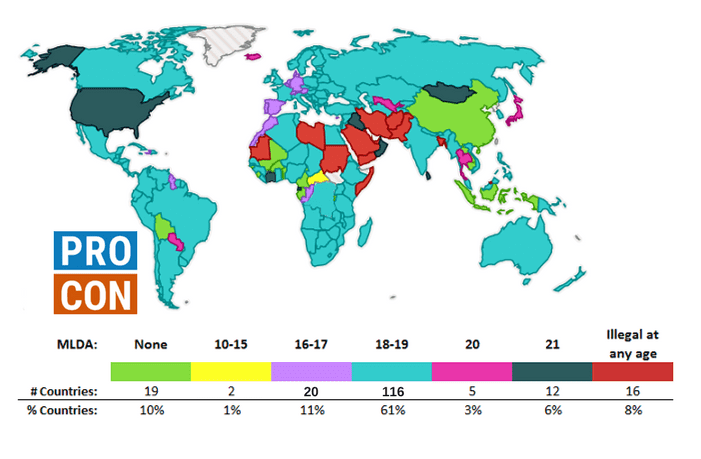
Alcohol. It’s what seems to be the forbidden fruit for many American teenagers until they reach the ripe old age of 21. Compared to the rest of the world, 21 seems a bit late to finally allow citizens to indulge in alcohol. Many European countries allow their taxpayers to legally buy and consume alcohol at age 18, some even as low as 16 years old (“Minimum Legal Drinking Age in Other Countries”). To many, it seems only natural that the U.S. should follow in the footsteps of the rest of the world and change the drinking age from 21 to 18, but to others, the 21-age stamp is here to stay.  

The drinking age is something of a continuous hot topic throughout America. It seems silly to many that at 18, someone can join the military, but they can’t join their buddies for a drink at the bar. They can get married, but they can’t celebrate with a glass of champagne. Many people against the idea of lowering the drinking age shake it off that it’s only teenagers who want this. That they want to be legal so they don’t have to keep sneaking around. While that may be true, and a large majority of the supporters for lowering the drinking age are in a relatively younger age bracket, there are many older adults who seem to feel the same. One in particular being 81 year-old Dr. Ruth C. Ensburg, a professor at Indiana University’s School of Public Health. At the beginning of this paper she wrote, “Why the drinking age should be lowered: An opinion based on research”, Dr. Ensburg does an effective job at establishing ethos. She’s researched this opinion she’s had for 30 years and has become somewhat of an expert in the topic. Throughout this essay, there are also many compelling statistics revolving around the use of alcohol and college students. This use of statistics enhances her claim that lowering the drinking age would be beneficial for the health of college age students. A particularly interesting statistic was that 22% of alcohol consumers under the age of 18 are considered to be heavy drinkers. This is compared to the 18% of people that reported consuming the same amount, but are legal drinkers (Ensburg). It seems to be that by raising the consumption age to 21, the American government has pushed unhealthy and irresponsible drinking habits on young adults. Later on in her essay, Ensburg covers the topic of responsible drinking. She goes to mention that because America has raised the legal drinking age, it has created an era of irresponsible drinkers. Percentages of unsafe and reckless acts have risen since the implementation of MLDA, the mandated legal drinking age (Ensburg). Another author, Kynslie Otte seems to agree with Ensburgs points. Otte points out that just because MLDA was enforced, it doesn’t mean that underage drinking stopped. The National Center on Addiction and Substance Abuse recorded that underage drinking is responsible for 17.5 percent of consumer spending on alcohol. MLDA didn’t stop the purchasing of alcohol, all it did was make young adults sneakier with their ways of purchasing and consuming alcohol. It pushes college students to more unsafe methods of drinking. Instead of being able to sit in a supervised bar or restaurant, college kids go to unsupervised house and frat parties where drinking and drug use is common. This can lead to injuries or situations that kids are too afraid to report to the authorities (Otte). Both of their articles target pathos, with their main point being it will keep kids that partake in these activites safer. These two articles corroborate with each other’s findings, making a compelling argument that lowering the drinking age, would in fact, be more beneficial for the younger generations’ health. I found a third article that is also in agreement with the articles I talked about above. Gabrielle Glaser published her article, “Return the Drinking Age to 18, and then Enforce it”, in the New York Times. She goes on in her article to explain how lowering the drinking age, would benefit the health of the younger population, which seems to be the reoccurring theme for people to talk about when talking about lowering the drinking age. Glaser talks about the rise in alcohol themed deaths in her article as well. She briefly mentions traffic deaths and chooses to focus more so on alcohol poisoning deaths, as well as the rise in hypothermia cases and falls. During the years of 1998 and 2005, the amount of alcohol poisoning deaths in 18 to 24 year olds, almost tripled, going from just 779 cases to a whopping 2,290 (Glaser). I find this statistic particularly interesting because Glaser chose to include ages that were over 21. Most people would think that because someone is 21, they understand how to drink responsibly, but that’s just not the truth. Glaser makes an interesting analogy in her conclusion paragraph about how society doesn’t just let a new, 14 year-old driver drive alone. They need to have an adult in the car, go through a whole class to get their license, and so on, so why is that not the case with drinking (Glaser)? Surely if kids were able to drink in a controlled setting and learn how to do it responsibly, there would be less problems related to alcohol consumption in our world.

However, not everyone is in agreement with the findings in the above paragraph. There are countless other studies that have been published that would say the safety of the people is endangered, were America to lower the legal drinking age. Most of these studies run along the lines of driving fatalities and alcohol, failing to account for other factors that could be attributed to their findings. Statistics reported by the CDC saw a 16 percent decline in automobile crashes after the enforcement of MLDA (“Minimum Legal Drinking Age of 21 Saves Lives”). Another article, published on verywellmind.com, agrees with the CDC’s research and simply puts that the higher drinking age is what is saving lives on the highway. The author, Buddy T, includes a rather persuasive statistic in his article that targets the pathos of readers, especially readers that are parents to people that fall into this age bracket, that drivers who are between the ages of 16-20 and who’s blood alcohol level is .08% and above, are 17 times more likely to die in a motor vehicle crash (T). This is extremely persuasive when both sides of this argument are concerned with the health of these younger drinkers. As mentioned earlier, pathos targeted towards parents or guardians is especially prominent within these articles. Yes they mention many statistics which would imply the use of logos, but all of these statistics are centered around the teenage years, where adolescents are still living with their parent or guardian. No one that loves a child in this age bracket is going to look at the statistics of drunk driving being reduced and think that lowering the age would be a good idea, which is something that the articles against lowering the drinking age do an effective job of portraying. It just goes to show that the basis of both sides of this argument are concerned with health and safety. One side thinks lowering it would save more lives, while the other thinks keeping it where it is at right now is what is saving lives. It’s an extremely important cultural debate because both sides think that they are saving the lives of not only the American youth, but the American people as a whole.

However, the articles mentioned above that use these statistics chalk up the fall in drunk driving crashes to raising the legal age, but fails to account for the rise of drunk driving education in schools, as well as tighter seatbelt and D.U.I laws (Glaser). Drunk driving education has been integrated into drivers ed courses, as well as the health curriculum in middle and high schools. They try and teach kids young what driving under the influence can do to your life in theory, but because the legal age is much higher than the age of kids in school, they don’t think about it, and in turn don’t truly learn how to be a responsible drinker. Whether law makers decide to change the legal drinking age or not, kids need to start becoming more educated when it comes to alcohol. We cannot continue to wholeheartedly preach staying away from alcohol in the schools until the legal age because that simply just isn’t feasible when looking at the data for underage drinking and alcohol sales. Kids will continue to find ways to get their hands on it whether the law changes or not, and school health courses need to cater to this and teach kids what being a responsible alcohol consumer looks like. Otherwise, the American society will continue to find itself at a crossroads when it comes to adolescents and alcohol.

Works Cited 

Engs, Ruth C. (1997, 2014). Why the drinking age should be lowered: An opinion based upon research. Indiana University: Bloomington, IN. Retrieved from IUScholarWorks Repository:http://hdl.handle.net/2022/17594. Accessed 9 November 2020.  

Glaser, Gabrielle. “Return the Drinking Age to 18, then Enforce it” The New York Times, The New York Times, 10 Feb. 2015, http://www.nytimes.com/roomfordebate/2015/02/10/you-must-be-21-to-drink/return-the-drinking-age-to-18-and-enforce-it. Accessed 11 November 2020.

“Minimum Legal Drinking Age in Other Countries – Drinking Age – ProCon.org.” Drinking Age, 18 Feb. 2020, drinkingage.procon.org/minimum-legal-drinking-age-in-other-countries/. Accessed 9 November 2020. 

“Minimum Legal Drinking Age of 21 Saves Lives.” Centers for Disease Control and Prevention, Centers for Disease Control and Prevention, 3 Sept. 2020, www.cdc.gov/alcohol/fact-sheets/minimum-legal-drinking-age.htm. Accessed 9 November 2020.  

Otte, Kynslie. “Kynslie Otte.” University News, 17 Sept. 2012, info.umkc.edu/unews/lower-drinking-age-could-mean-safer-consumption/. Accessed 9 November 2020.  

T, Buddy. “Why Facts Don’t Support Lowering the Drinking Age to 18.” Verywell Mind, 4 Feb. 2020, http://www.verywellmind.com/the-lower-drinking-age-debate-63724. Accessed 11 November 2020.

Should the Electoral College be abolished?

The Electoral College was a system originally designed by the Founding Fathers as they were attempting to figure out how to elect a president. At the time of the Constitutional Convention, no other country in the world directly elected its chief executive, so the delegates were in uncharted territory. One group of delegates felt strongly that Congress should not have anything to do with picking the president. Another group was set against letting the people elect the president by a straight popular vote. They came to a compromise based on the idea of electoral intermediaries. The states would each appoint independent “electors” who would cast the actual ballots for the presidency.

Every four years, when it comes time to enter a new election season and a voting is on the horizon, concerns surrounding the electoral college surge to the forefront of the media. The Electoral College is made up of 538 electors who cast the votes that formerly elect the president. Each state has one elector per senator and state representative. Because of this, citizens call into question the power of their own individual vote. Now, in retrospect this debate seems very clear. Those in favor of abolishing or altering the electoral college, and those who wish to uphold the system. However, as you look further into the argument, it offers crucial insight surrounding its original intent, racial discrimination, partisan biases, geographical significance, and how it effects federalism and democracy.  

Defending The Electoral College

The essay written by Allen Guelzo and James H. Hulme, “In Defense of the Electoral College” frames an argument as to why they believe the Electoral College is relevant. In this piece they delve into the presumed misconceptions about the system, and complete an extensive refutation. They go about this in a very strategic way. The idea they seem to accentuate is the democratic ideals of the American people. They realize that at the very heart of this country is the principle of freedom, and they tailor their argument to that coveted American precedent. This essay emerged in 2018 after the 2016 election when Donald Trump was elected president by the Electoral College votes after Hillary obtained more popular votes. Because of this, the scrutinization of the Electoral College was at an all-time high, and Guelzo and Hulme felt the need to defend it. They open the piece with a line exclaiming that

“There is hardly anything in the Constitution harder to explain, or easier to misunderstand, than the Electoral College.”

The significance of opening with this line is to introduce the idea that the reader may not fully understand the concepts of the Electoral College. Insinuating that this essay will enlighten their perspective so they can create better assumptions.

They immediately dive into the arguments made against the Electoral College. They use quotes from The New York Times, The Washington Post and Time Magazine, which are historically reliable sources, to allude that they did not just selectively pick easily refutable claims. When describing the evidence of their naysayers, Guelzo and Hulme do seem to adopt a tone that suggests their opponents are overreacting. They utilize words such as “scathing attack”, “complained”, and “demand” to represent the other side as a bit ridiculous in their claims about racial issues, political polarization, campaigning influence, and voter suppression.

So, after placing the opposing arguments first, they then begin their refutation of those claims separated into five categories. A fact that they repeatedly underscore is that “the Electoral College is the only method specified by that document for selecting the president of the United States.” They are hoping to help naïve voters comprehend the absence of a popular vote mention within the Constitution. However, this seems a bit ineffective and it draws a similar connection to how certain branches of religion sometimes weaponize or manipulate the Bible’s words. Nonetheless in this section Guelzo and Hulme offer clear evidence within the constitution and focus on hitting that nerve.

Within their piece, they definitely place the Founding Fathers and the Constitution in a place of superiority. In doing so I think they fall short by consequentially criticizing the American people. They seem to be speaking to the American voters, but more so the younger generation. With the presence of the phrases “misunderstand”, “stupidity”, “misguided”, “poorly comprehended” and “worst human impulses” it connotes more of an attack on people, and those who specifically do not understand the full story of the Electoral College. This possibly suggests that Americans have tendencies to blindly follow popularized beliefs without researching all the facts.

I think their essay opens the conversation on how we as Americans have defined our democracy. Guelzo and Hulme seem to view these federal doctrines as the soul and center of American culture. Through their writing, they aspire to engender concern, and ultimately “protect the nation” and defend the Electoral college. In doing so it comes into question if they are truly defending democratic principles to benefit the country, or if are they safeguarding the politicians they idolize due to their internal skepticism and fear of giving too much power to the people. Nevertheless, it offers valid insight and clearly outlines the influence of federalism in America.

Against The Electoral College

Alternatively, in the Ted Talk “One Person, One Vote” Justin Curtis frames a very different argument, based in substantial data, for why the Electoral College system is corrupt. In this meticulously crafted speech, Curtis offers an urgent and poignant tone, that places demand on the audience. He begins by relating to the average American voter by similarly expressing American values, and boldly claims

“our presidential elections effectively disenfranchised millions of Americans.”

By utilizing this phrase and phrases alike, he is preaching that this phenomena is directly effecting countless Americans, not just a minute community, and therefore deserves to be addressed.

He then touches on the idea of political campaigns. When talking about these campaign trials there is a purposeful abundance of math equations he uses. The plethora of numbers and formulas that Curtis exposes is critical to his claim. They serve multiple purposes. He includes them to increase his credibility with tangible data, and I believe he also is attempting to show that this system reduces American citizens down to a number. Largely dehumanizing them. This is strategic move, and he realizes that for most people this is a tough pill to swallow. It inadvertently expresses that the idolized politicians do not care about the audience, and that they are just a useless number.

He also consciously extracts examples from both parties, and seems to specifically provide statistics from relatively respected presidents. He is aware of the partisan nuances that accompany this debate a remains neutral.

A prominent word that he emphasizes various times throughout the speech is “spectator”. The calculated use of this word seems to serve as his way of nudging the ‘average joe’. A spectator of a sport is simply captivated by the players, and lives vicariously through them. Americans, who are romanticized for their stardom and glory, do not want to hear that they are a mere spectator in their future. Drawing this undesirable connection, Curtis is trying to belittle the electoral process in the eyes of citizens. This may be a key moment noting that the government might enforce this system to give Americans the illusion or sensation of choice, when, as Curtis exclaims again

“your vote might not make a difference, but your voice does”

He plays into this distinct idea and weaves it in his argument. In his assertion, he refers to the other side of the debate as a radical and nonsensical. He maintains a condescending tone when on the topic, with phrases such as “straw man arguments”, “idiosyncrasies”, “crazy”, “sinister”, “unjust and unjustifiable”. This accusatory tone can be interpreted as a direct dismissal of his protesters, and may not appeal to observers. When mentioning the naysayers, it seems like he quickly brushes off the claims and follows with a patronizing challenge. This is a potential blind spot in his argument.

However, a strong point he makes is within his refutation is based on race relations. Contrary to the article above he goes into further detail on the historical significance of slaves and the three-fifths clause. This section calls into question how we allow historical principles to manifest in today, when they were cultivated upon the ideals of racial discrimination and segregation. And is the desire to preserve them indicative of  the nations robust prejudiced nature? Overall he gives examples to back his claims that resonate with the audience and are relevant to the topic. In his speech Curtis explicitly targets the people. He seems to be preaching to the average American, but also castigating the government. This can both benefit and discredit his views.

“we can forge a government of the people, by the people, for the people”

With this as his closing line he is aggregating a more positive connotation and is really pushing to inspire action, not diminish it.

Mapping Out The Electoral College

Believe it or not those two maps are attempting to display the same data. It is key to note that this is the most prevalent medium in which Americans consume the Electoral College statistics. Right away each map creates a unique narrative surrounding partisanship. The distinct blue and red. These maps offer a pervasive influence over someone’s opinion of the Electoral College. Because it is the most common form of Electoral College media, it majorly affects different partisan views. These swayed perceptions can be interpreted as the fault of the consumer, or as a fatality in the Electoral College narrative.

Nonetheless, the lower map was the chosen delegated poster child for Electoral College maps. It is the perspective map for the current presidential election. It is notable that delegates chose this map as the means to represent our democracy. This translation of democracy, however, excludes a large population, and generalizes regions with the use of one color per state. When, in fact, there many different party affiliations present in all states.

When republicans see an expanse of red on the lower map, they are more inclined to accept that version of democracy, the Electoral College, than democrats. Democrats are more likely to accept the upper map. An entirely different definition of democracy.

Focusing on either map could lead to different perceptions of the Electoral College and the election in general, creating massive divides. It is evident especially in today’s climate.

These respective maps do not seem to operate in the argument of for or against Electoral College necessarily. But, they reiterate a different perspective on how the governing bodies decide to portray their image to the American people. Are these cartographical choices calculated and deliberate to sway viewpoints and preserve electoral systems, or are they just misinterpreted? Either way it is important to realize that the issue lies in believing that any single map can ever tell the whole story. The designers of these maps had clear aims to manipulate different outlooks. None are right, and none are wrong necessarily, but they all allow you to interpret the results differently.

Concluding

The Electoral College is a system that is undoubtedly symbolic of the state our country is in today. It reveals covert nuances and spotlights lots of critical controversies within our governing bodies. It has remained constant for over two hundred years. With the impending idea of whether or not to uphold or abolish it, the underlying implications of democratic ideals, racial priorities, media consumption, and partisan biases are essential to consider. Leaving many Americans with the complicated question: does democratically voting to abolish a system that is supposed to uphold democracy substantially democratic? Not to mention that that very system could also be threatening our democracy. Just another multifaceted issue that needs to be addressed by citizens in this ‘democratic’ nation.

Work Cited

2020 presidential election results. (n.d.). Retrieved from https://edition.cnn.com/election/2020/results/president?iid=politics_election_bop

A Great Example of Better Data Visualization: This Voting Map GIF. (n.d.). Retrieved November 15, 2020, from https://www.core77.com/posts/90771/A-Great-Example-of-Better-Data-Visualization-This-Voting-Map-GIF

Guelzo, A., Allen Guelzo is the Henry R. Luce Professor of the Civil War Era, Drutman, L., & Bhidé, A. (n.d.). In Defense of the Electoral College. Retrieved November 15, 2020, from https://www.nationalaffairs.com/publications/detail/in-defense-of-the-electoral-college

“One Person, One Vote”

Should abortion remain legal?

Melinda Beck

Abortion has been debated for decades , and it is still a topic that got discuss often between American. Abortion is defined as ” a procedure to end a pregnancy. It uses medicine or surgery to remove the embryo or fetus and placenta from the uterus.”  (Medlineplus).A little throw back when the 45th U.S. President Donald Trump dominates Amy Coney Barrett as the new supreme court, some people are against this choice because they are concerning that she will make abortion illegal, there are also some people glad for her choice, so more life will get saved. (GONZALES) There are couple popular opinion about abortion:” Should abortion remain legal? If yes, to what level? If not, why and when that should be illegal? ” These questions’ answer are not just simply yes and no, it’s an answer that need to be discuss. Not between you and me , not between nations , but between moral and legislation.

The middle ground of Pro-Choice and Pro-life

Pro-life? Who’s life?

There are two main side in the debate about abortion, Pro-life and Pro-choice. “Pro-life” values the right of the fetus to gestate to term and be born. The personhood of Fetal is one of the majority argument that pro-life group is having. On the website, “Pro-life action league”, it describe the starting of the life should be the fetus, even they don’t look like adult, they should still have the right of survive and get taken care of . ” For that matter, neither is an embryo less human, though it looks quite strange to our eyes, even in comparison to a fetus. Still, it is our duty to recognize our common humanity at all stages of development.”(Pro-life action league) Pro-life group thinks fetus has rights to survive. So it shouldn’t be legal. Also, as Pro-life activities points out that abortion hurts women’s physical and mental health. For an example, Study shows, abortion Increases woman’s Risk of Premature Death by 50%. So for the long run, abortion should not be considered, no matter is for the health of the pregnancy women or the human rights of the fetus.

Associated Press

Pro-choice? Who has the control over the choice?

On the other side, Pro-choice group is holding the law. Back to January 22, 1973, Roe vs Wade ruled that the Constitution of the United States protects pregnant woman’s rights to choose to have an abortion without excessive government restriction. Margaret Sanger, as the founder of the planned parenthood wrote: “No woman can call herself free until she can choose consciously whether she will or will not be a mother.” The majority argument that pro-choice is women have a moral right to decide what to do with their bodies. More deeply, they want the chance for women to be able to achieve their full potential in life instead get stuck with children. (BBC news)Pro-life group thinks the right to abortion should be as equal to as the pregnancy rights that women having. They can decided to having the children, or not, or choose to have a non biological family member later in the life.

Legislation VS Moral : who should we listen ?

Overall, both sides are auguring for two points, the future of the mother(wether she has the ability to taken care of the children and the self health concern), and should the fetus be considering as a human or not. The current law for abortion in the United states are, four states (Arkansas, Kentucky, Missouri and Tennessee) adopted legislation that would ban abortion if the U.S. Supreme Court were to overturn Roe v. Wade, four states enacted bans based on the patient’s reason for seeking an abortion, Nine states are banned abortion based on certain age of the fetus. Specially, Alabama enacted a total ban on abortion, at any point in pregnancy. (guttmacher Institude) Some of these reasons of banning abortion are consider of the violence reason, almost all of the states are agreeing that if women got raped, she has the right to not keep the baby. And that leads to a question, when a women’s human rights got violent, does the fetus still having his human rights to survive? Some people might say no, because the baby will keep reminding the mom what she has been going through. Some people might say yes, the baby did nothing wrong, the only wrong one is the criminal. This reaches to the base of our legislation, that is, what is the law actually based on? Forcing the mother to keep the criminal’s baby is immoral, letting it is not. having a religious belief and willing to share the believe to others is moral, but forcing others to accept and even passing on a law to reinforce it, is not. To have the control over our own body is moral, but if the power impact to other’s life and death, it suddenly it is immoral. The question of should abortion remain legal, it is actually asking, should we based on people’s moral standard to passing a law, or should we based on biological standards and medical reason to passing a law, or even ask a more earlier question, how to stop unplanned parenthood from first place?


Citation page:

  1. Erica Gonzale, “What Is Amy Coney Barrett’s Stance on Abortion Rights and Roe v. Wade?” Bazaar, https://www.harpersbazaar.com/culture/politics/a34167818/amy-coney-barrett-roe-v-wade-abortion/
  2. Medline plus, ” the words defination of abortion”, https://medlineplus.gov/abortion.html#:~:text=An%20abortion%20is%20a%20procedure,a%20pregnancy%20is%20very%20personal.
  3. Grace Wyler, ” The New Face of the Anti-Abortion Movement”, vice. https://www.vice.com/en/article/exmngz/the-new-face-of-the-anti-abortion-movement
  4. BBC © 2014, ” Discussion between the aboration”,BBc news http://www.bbc.co.uk/ethics/abortion/mother/for_1.shtml#h4
  5. Pro-life action league © 2020, Q & A section, https://prolifeaction.org/fact_type/pro-choice-arguments/
  6.   Reardon DC, Thorp JM.  Sage Open Medicine.  Vol 5:1-17, 2017. Pregnancy associated death in record linkage studies relative to delivery, termination of pregnancy, and natural losses: A systematic review with a narrative synthesis and meta-analysis
  7. Gutter macher Instutuide. ” State Policy Trends 2019: A Wave of Abortion Bans, But Some States Are Fighting Back”, December 10, 2019https://www.guttmacher.org/article/2019/12/state-policy-trends-2019-wave-abortion-bans-some-states-are-fighting-back

Is Abortion Right or Wrong?

Abortion is a very controversial topic in our world today. Perspectives on abortion differ and the conversations tend to become less civil due to the strong values individuales hold close to them. These values stem from multiple beliefs; whether it be from religion, family, or friends. On one side people believe in the freedom of choice and that a women should not be withheld the right to choose. However, others believe that abortion is murder and that even a fetus is a human being that deserves to have a life. Due to these beliefs there is a strong conflict of opinion, which causes women to feel pressured into what kind of path to go down on.

One way women feel pressured with their decision on abortion is the opinion of their family. Family members can be very controlling and they have a strong influence on what that person will do. This influence can cause many conflicts to occur within a family and the topic of abortion can severely damage relationships. During a Ted Talk about abortion Josiah Friedman, the founder of the prominent movement Voices for the Voiceless, speaks at Grand Canyon College about how women should not face unplanned pregnancy alone. Within this Ted Talk Josiah explained that abortion is not wrong or immoral but it is a “void for connecting” (Friedman). Within this Ted Talk Friedman gave many examples to project his message to his audience but there was one example in particular that really expressed his points. He explained that when his mother was 19 years old she became pregnant but chose to get an abortion because of her father. Friedman’s mother felt her father would cut all connections and disapprove of her and her husband. She felt forced to get an abortion and never tell her father. After the procedure she experienced unnatural bleeding and went to the hospital and later received a bill stating the bleeding was from post abortion. Luckily she got to the bill before her father and begged the hospital to change it so her dad would not find out. They agreed and he never ended up finding out the truth. This is one of hundreds of examples that Friedman has about women being pressured into getting abortions. The decision that Friedman’s mother made was solely because of her family and the pressures she felt from them. This example from Friedman really helped capture his message and emotions towards abortion. His perspective is that people’s views need to change and that abortion is not immoral it is a positive resource but because of judgments it is looked down upon.

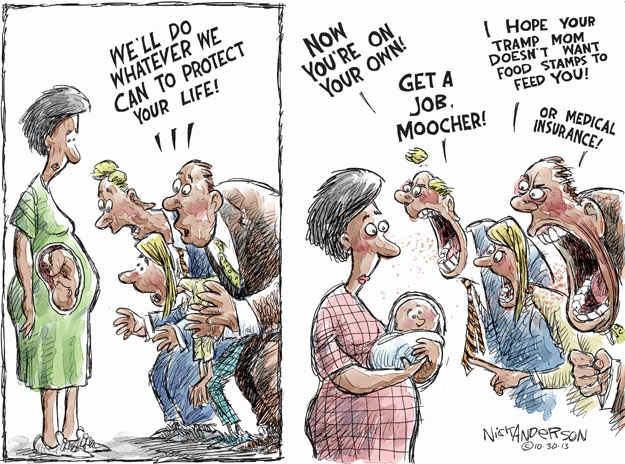
Nick Anderson, a political cartoonist for the Houston Chronicle expressed a different perspective towards abortion through one of his cartoons.

In this cartoon Anderson shows similarities and differences to Friedman. Anderson’s perspective on abortion shows similarities to Friedman’s perspective because in this cartoon we can clearly see the family being supportive while the women is pregnant but once she has the baby we see the family getting extremely angry and judgemental. Just like Friedman this cartoon by Anderson also explains how there are too many pressures and too many opinions from outsiders when it comes to the topic of abortion. However, Anderson’s cartoon also differs from Friedman’s point of view because in this cartoon we see the family delivering pressure and judgments once the women has had the baby as opposed to Friedman’s perspective where the pressures and judgments come in the beginning stages of pregnancy. In the second part of the cartoon the father is visibly expressing strong emotion towards the daughter. On her face we can see Anderson drew red to show that she feels embarrassed and ashamed. Anderson specifically did this to demonstrate how the judgments and pressures make the women who are pregnant feel. When women feel these pressures from their family it truly affects the course of their life and takes a toll on them.

A Polar opposite perspective from Friedman’s and Anderson’s views is expressed by Samuel Sey. Sey, a community liaison at the canadian centre for Bio-Ethical Reform, explains that when someone gets an abortion they are breaking the rules of God and in fact slaughtering human beings. People’s perspectives on abortion tend to be strongly associated with religion and that person’s beliefs. Religion is not only strongly associated with peoples perspectives on abortion but religion also creates a passion that drives people to get very aggressive with their point of view. This is strongly demonstrated in Sey’s writing. In Sey’s article, “Murders That Won’t Go Viral“, his tone is very explicit and aggressive. He purposely dives deep into the truths and horrors of abortion to really grab his audience’s attention and show them why abortion is wrong. In this article Sey states, “Abortion crushes the babies head. It rips them apart, limb by limb” (Sey 1). Due to choosing these specific explicit words we see how passionate he is towards his argument. Also because of his specific word choice and tone we can come to the conclusion that if someone with an opposing view discussed this topic with Sey he would respond more aggressively and harsh therefore not tolerating any alternate view points contributed to the discussion. Sey through his writing heavily appeals to his audience through religion. While discussing why abortions are murder he states “Our God says, Rescue those who are being taken away to death, hold back those who are stumbling to the slaughter” (Sey 1). Sey believes that there is a strong connection between his view point and religion. Many other individuals make this connection causing them to be stubborn with their viewpoints and not open to any suggestion. Sey’s opinions strongly differ from Friedman and Anderson’s perspectives because they feel that a women deserves a choice where Sey strongly believes in religion and that abortion is killing a live human being and that abortions were not meant for this world.

Abortion plays a large role in the psychological state of a women. Although the main debates are whether abortion is right or wrong the procedure, stress, and decisions can really traumatize a women. Lisa Tolin, an experienced journalist and editor for TODAY digital, covered a study about the psychological after-effects of abortion. In her article “The Effects of Abortion“, psychologists Nancy Felipe Russo Ph.D. of Arizona State University, and Amy Dabul, Ph.D., of Phoenix College discussed that the best way to understand a women’s mental health after the abortion is to know her state of mind previous to the pregnancy. while discussing their findings Tolin states “In other words, those who found the procedure traumatic were generally troubled long before they showed up at an abortion clinic” (Tolin 1). While women are in this fragile state they are very vulnerable and stressed. This makes it extremely hard because while they are going through all of this they have friends and family trying to tell them what to do and what not to do. All of these factors and pressures feed into a women’s mental state making it very hard and frustrating for them. The overall process of abortion and unplanned pregnancy can be traumatic and leave women in a poor psychological state. In addition to discussing a women’s mental state this study heavily contrasted Sey’s article and his views. This study conducted by Nancy and Amy found that the women’s affiliation to religion had no effect on them getting an abortion. Women of the catholic religion were just as likely to get abortions as women of a different religion.

All together there are many perspectives on abortion that differ. After reviewing these four sources conflicts of opinions are very visible and has a strong effect on our society. Although all of the sources share different viewpoints on abortion they all connect together in some way. There is never going to be a correct answer on whether abortion is right or wrong but societies viewpoints can become more open and understanding to make it easier on the women going through this unexpected and stressful time.

Worked Cited

Friedman, Josiah. “a Conversation around Abortion and Community.” Bing, Microsoft, 2019, www.bing.com/videos/search?q=abortion+ted+talks.

Sey, Samuel. “Murders That Won’t Go Viral: The Quiet Injustice Too Few Protest.” Desiring God, 15 Nov. 2020, www.desiringgod.org/articles/murders-that-wont-go-viral.

Tolin, Lisa. “The Effects of Abortion.” Psychology Today, Sussex Publishers, 2016, www.psychologytoday.com/us/articles/199707/the-effects-abortion.

Anderson, Nick. “Political Cartoon.” You Are Being Redirected…, 2013, www.cartoonistgroup.com/cartoon/Nick Anderson’s Editorial Cartoons/2013-10-30/103439.

Should Professional Athletes Be Required to Attend College?

Fight for 18! Why is college necessary to be a professional athlete? -  Chicago Tribune

Education is essential to learning life skills for intricate careers and ways to succeed in life. In 2020, people who have obtained a bachelor’s degree make an average of twenty to twenty-five thousand more dollars a year than those who just have their high school diploma. There are plenty of benefits that come from a college degree. Education is the backbone of the world’s future, but should it be forced on people who can find great success in other fields that don’t necessarily need a college degree?

Athletes should not be forced to attend college:

While education is definitely something that should be prioritized in life, college education isn’t absolutely necessary for every career path. We know this to be true, considering we see many actors, musicians, and artists make exceptional livings in their respective fields without a college degree. Competing in the world of sports is similar to these careers in two aspects: fame and money. If someone like Leonardo DiCaprio doesn’t have to attend college to become one of the world biggest stars, how come “The GOAT”, Tom Brady needed to attend a 4 year university just to compete in the National Football League?

“Again, the importance of education should never be questioned. But if other “entertainers” can dropout of high school to pursue a dream career, why then are football and basketball players forced to attend college, just to be eligible for the NFL and NBA.”

Blake Miller: Miami’s Community Newspapers

Often, successful college athletes end up earning scholarships to attend a college and participate in the NCAA, but they’re coerced into a competitive, time consuming system. In the NFL and NBA, athletes are forced to attend schools and play on those teams until colleges show an interest in them. Instead of playing sports professionally where athletes get paid for their performance, athletes are forced into a system where they do not get paid, cannot make money through promotions and marketing, and cannot even work an outside job to provide for themselves. There are many athletes who play professional sports who played sports at a collegiate level who don’t succeed in school. Not all athletes are interested in a college degree and many athletes who go on to play professional sports don’t end up earning their degree after 4-5 years of schooling. Now, college is important in 2020 more than it ever has been before, but it’s not the organization’s decision to demand all athletes go to college just so they can be noticed. Athletes should be able to attend professional combines or training camps without being looked over and dropped when the coaching staff finds out they never played in college.

I feel as if this requirement the NFL and NBA have for all college athletes to attend a college hints at other stereotypes that all athletes seem to be caught up in. The most popular athlete stereotype that is prevalent in all sporting industries is that all of them are jocks and not much else. These massive organizations seems to somewhat agree with this way outdated stereotype, considering they feel college can protect these athletes when they’re out of the sporting world. What many people may not understand is that in all schools, athletes need to maintain a certain GPA to be able to participate in their individual sports.

While there are clear issues that athletes should not need to face to live out their dreams, college importance should not be taken for granted. This being said, many athletes come from impoverished areas and want to make money to support their families or themselves on their own timeline. Athletes shouldn’t have to buy in to the stereotype and go to school if it’s unrealistic or unnecessary for them.  That’s why some believe we should start allowing athletes to forgo the ABCs if they simply wish to pursue a PDQ plan, pretty darn quick – and I agree.

Young athletes, a degree matters

Professional athletes are now allowed to participate in the Olympics. In basketball, the large salaries that are commonplace for NBA stars have had a dramatic effect on the way young hoopsters move from high school to the professional ranks. In the NBA and MLB and other sporting industries, professional teams have the ability to pluck students after high school. Many players still choose to enroll for the minimum amount of semesters to be eligible for the draft, where there can be a lot more opportunity for a blossoming athlete. Other athletes think that since they’ll be making the big bucks in the pros, how could they possibly need a college degree. What’s missing from this predicament is that a college diploma is more important now than it has ever been for athletes who intend on signing a large contract.

Athletes who are not educated in finance and basic money management cannot hold onto the fortunes they acquire in the big leagues. Athletes these days make so much money that they don’t always have the ability to manage and protect the enormous sums of money they receive. This is not a lack of intelligence on the athlete’s part, but often people who make smaller amounts of money have learned how to save and budget. Money management comes from previous knowledge and experience and athletes can take these skills for granted. For the average athlete, their life experience up until their professional careers hasn’t given them the abilities to handle their money and not blow it all once they leave the league.

“This has nothing to do with a lack of intelligence on the athletes’ part. For so many of them, the lack of experience with money is their Achilles’ heel.”

Kareem Abdul- Jabbar: ESPN College Sports

This is NOT the case for all athletes of course. Many athletes work in their sports industries after their athletic careers and venture off to totally different career paths and find success this way. There are many pathways to find success in the world. Of course, there have been athletes who get the concept with regard to money management. Former NBA star Dave Bing is presently the mayor of Detroit. Since his NBA career ended, he has had a successful business career as a producer of steel products and he went from that success to a political career that has given hope to his beloved Detroit. The hope is that young athletes can do a better job discovering who they are and can be without their sport. Taking advantage of a college education is a great start to doing so.

This need for college implemented by multiple sporting organizations doesn’t make an athlete feel as if they are self sufficient, yet they make absurd amounts of money. These feelings throughout the sporting world compares an athlete to a cheesy, reckless rockstar, who has no concept of money during their careers and after end up broke with no education and no job opportunities. This seems an unfair comparison, considering that many athletes go on to do big things off the field once their short careers come to an end.

https://www.espn.com/college-sports/story/_/id/8344785/young-athletes-degree-matters

According to the graphs above, these statistics prove that athletes cannot always manage their money after their careers. As statistics show, sixty percent of all athletes in the NBA go bankrupt within 5 years of leaving the league and seventy-eight percent of NFL players go bankrupt in only 2 years after leaving the game. This just goes to show that many players struggle to budget after leaving the league. This just goes to show that a college education can prove a valuable resource not only when athletes are signing large contracts but as well as after they leave the league.

These statistic emphasize the importance that Kareem Abdul- Jabbar discuss when he tells student-athletes that college is important no matter how much money a professional athlete makes during their career.

https://www.owpfn.com/athletes

Ted Talk: Not Enough Time in a Student Athlete’s Day

In this Ted Talk, high school student-athlete, Paul Baynes discusses the never ending issues that a student athlete faces on a daily basis. In the talk, Paul lays out his daily schedule, which consists of school, football practice, homework, studying game film, and of course consuming food and water. Paul wakes up at 6:45 AM and attends class, practices, and studies until 12:00 AM when he finally lays down in bed to prepare for “a good night’s sleep”. Considering Paul is in high school, where students have a lighter workload and practice schedule. In college, most athletes, specifically football players, have a heavy workload, an overwhelming practice schedule, and need to travel out of state every-other weekend.

He even goes in to discuss the statistics of grade improvement based on sleep schedules. He talks about different studies conducted by Stanford and the University of Wisconsin that students have on average 4 hours of homework every night and that only fifteen percent of students get more than seven hours of sleep per night. Another study done by the KU University in Belgium concluded that students who got an extra hour of sleep performed on average ten percent better on an exam than students who got less than seven hours of sleep. This issue is especially precedent for multi-sport athletes who never get a season off or who’s seasons may even overlap.

Citations:

Blake Miller, et al. “Athletes Should Not Be Forced to Attend College.” Miami’s Community News, 16 Mar. 2018, communitynewspapers.com/coral-gables-news/athletes-should-not-be-forced-to-attend-college/.

Abdul-Jabbar, Kareem. “Young Athletes, a Degree Matters.” ESPN, ESPN Internet Ventures, 6 Sept. 2012, http://www.espn.com/college-sports/story/_/id/8344785/young-athletes-degree-matters.

“Athletes.” One Wealth Partners, http://www.owpfn.com/athletes.

Baynes, Paul. “Not Enough Time in a Student Athlete’s Day.” TED, http://www.ted.com/talks/paul_baynes_not_enough_time_in_a_student_athlete_s_day.

Government Surveillance: National Security or Personal Privacy

On September 11th 2001, hijackers flew planes into the Twin Towers, the Pentagon, and an empty field near Shanksville, Pennsylvania. The nation was in shock. Questions were raised on how people could have committed such an unspeakable tragedy on American soil. Beyond all the talk about the attack was one crucial question for the future of American security: What do we do next? The United States created a new department called The Department of Homeland Security, new agencies like the TSA were formed, and a controversial act called the Patriot Act was passed giving the US Government broad power to enact new surveillance programs in ways they never could before. While the Patriot Act could help encounter and stop threats of terrorism both at home and abroad, it added a new dimension to American intelligence agencies not seen since the Cold War: the ability of the American government (more specifically the FBI, CIA, and NSA) to spy on its own citizens. The rise of government surveillance leads to debates over the role of security in the United States and the rights to personal privacy. Foundational to this discussion is the issue of individual and collective understanding of when infringements on freedom are necessary to protect/secure our rights.

Holding the title of a global superpower, the United States generates a lot of attention from people all over the world. While the attention can lead to forging powerful allies, it can also lead to the emergence of many enemies. In order to curtail threats to our nation, most people agree some type of surveillance is needed, but many disagree on the tactics used and the effects of them, especially when the general public is not aware. This is the case with Edward Snowden, an NSA whistleblower who is a fierce critic of United States government surveillance and the author of the essay “Edward Snowden: The World Says No to Surveillance“. Snowden is in exile in Russia for exposing classified documents that showed the NSA’s call tracking program that allowed the government to track and monitor phone calls of everyday Americans with no warrant or need to justify it. While that program was later struck down by the courts, he acknowledges that people’s privacy is still not secure.

Billions of cell phone location records are still being intercepted without regard for the guilt or innocence of those affected.

Edward Snowden

Snowden lays out a major concern he still has over privacy. Millions of law-abiding citizens are having their privacy taken away by an overreaching government, with little consequences or accountability. Snowden appeals to freedom and equality, two core beliefs of the American public, to make his argument against mass surveillance. He refutes the notion that these measures are necessary to secure the safety of Americans and views it as a government trying to gain information on its citizens for its own benefit.

On the other side, we see a need for government surveillance as a way to protect American citizens and American interests around the world. Edward Snowden was (and still is) very controversial, as he has been seen as endangering the security of american citizens and their interests. This is the view of two representatives, Mike Rodgers and Dutch Ruppersberger, members of the House Committee on Intelligence and authors of the op-ed “No, Edward Snowden does not deserve a pardon, President Trump“. While the piece is directed at President Trump, it describes in detail the harm caused by whistleblowers like Edward Snowden.

Snowden undermined the United States’ international relations, threatened our national security and jeopardized the sources and methods used by our dedicated intelligence professionals.

Mike Rodgers and Dutch Ruppersberger

Rodgers and Ruppersberger try to appeal a collectivist mindset that the US must work with its citizens to strengthen security. Part of that is accepting that the government needs to have some sort of system to monitor potential threats, and any leak of that system puts everyone in danger. They also try to discredit Snowden as being a hero of the people by showing that he got payed more than 1.2 million dollars in speaking fees because of his actions. Rodgers and Ruppersberger try to use money to show how Snowden could have been corrupted by fame and money to go against the best interests of his country. This approach is targeted at average Americans who could only dream to make that amount of money in less than 10 years.

Government Surveillance is no way a uniquely American concern, as every nation has to contend with its domestic impacts. Each country has some level of surveillance. However some countries don’t have the capabilities or needs for mass surveillance, while others find mass surveillance critical for security, as well as for political and economic interests. One country that falls in the later category is China. Since the rise of Xi Jinping in 2012, China has invested heavily in mass surveillance, particularly artificial intelligence for use of tracking its massive population. Ross Andersen speaks about China’s mass surveillance in his article “The Panopticon Is Already Here“. He writes:

Xi also wants to use AI’s awesome analytical powers to push China to the cutting edge of surveillance. He wants to build an all-seeing digital system of social control, patrolled by precog algorithms that identify potential dissenters in real time.

Ross Andersen

Ross Andersen, like most Western media members, portrays China’s ambitions in a negative light because it goes against the values of much of the free world, particularly the ability to speak freely and voice criticisms. While these values have never been stressed in modern China, the potential of these new technologies could prevent a free democratic China from ever becoming a reality, as any possible resistance would be suppressed before having a chance to organize. Andersen uses the words “all-seeing” and “social control” to scare people and portray both mass surveillance and the Chinese government negatively.

China is not the only country looking to use mass surveillance to spy on its own citizens. Israel has always been a leader in surveillance because its survival as a nation depends on it. Israel is a nation with powerful enemies who have sought to destroy the Jewish state since its founding in 1948. Recently, Israel’s Shin Bet ( the Israeli version of the FBI) has been using its surveillance capabilities to spy on its citizens during the coronavirus pandemic. Tom Bateman, author of the article “Coronavirus: Israel turns surveillance tools on itself“, writes:

The Shin Bet can access the location data of millions of mobile phone users to trace those who have been in proximity to confirmed patients. Israel credits the system, among other measures, with reducing the rate of infection.

Tom Bateman

For the first time ever in Israeli history, The Shin Bet can use phone GPS data to monitor Israeli citizens. This surveillance brings Israel closer to China in that respect. However the narratives are drastically different. Instead of being seen as something to be afraid of, Bateman frames this new government surveillance of citizens by Shin Bet as a positive and more like a civic duty for Israelis to comply with, instead of an overarching government limiting the freedoms of the masses that needs to be put in check. What is interesting about this argument of civic duties is that it is the exact same argument that China uses to justify its use of mass surveillance on its population. The only difference is that China is a single party state with no individual freedoms while Israel is a multi-party democracy, and possibly more important, a key ally of the United States and the Western world where many journalists covering stories of mass surveillance originate from.

When it comes to surveillance one word gets brought up: freedom. As Americans we hear this word constantly. Freedom is a virtue of American identity and culture. What is often forgotten is the fact that word freedom is subjective. We see this in American society today during the coronavirus pandemic with states implementing lockdowns and mask mandates to stop the spread of the coronavirus. This angered many people across the country. In Michigan, armed protestors stormed the capitol building to try to demand a lifting of the restrictions imposed to stop the spread of the coronavirus. Some people, like the ones protesting mask mandates, see freedom as being able to ignore government rules and regulations that they consider extreme. This is how Edward Snowden viewed freedom and why he leaked classified information. On the other hand, freedom can also be interpreted as the ability to be safe and secure from threats both foreign and domestic. This is the definition of freedom that persisted after 9/11 and allowed all of the post 9/11 changes like heightened airport security and increased surveillance to become reality. By not coming to an agreed upon interpretation of freedom in this country, we will remain divided on the accepted level and value of security and surveillance. This battle between privacy and security has been a part of our nation’s history and will continue to be so for the foreseeable future.

Work Cited:

Andersen, Story by Ross. The Panopticon Is Already Here. 30 July 2020, http://www.theatlantic.com/magazine/archive/2020/09/china-ai-surveillance/614197/.

Bateman, Tom. “Coronavirus: Israel Turns Surveillance Tools on Itself.” BBC News, BBC, 11 May 2020, http://www.bbc.com/news/world-middle-east-52579475.

Censky, Abigail. “Heavily Armed Protesters Gather Again At Michigan Capitol To Decry Stay-At-Home Order.” NPR, NPR, 14 May 2020, http://www.npr.org/2020/05/14/855918852/heavily-armed-protesters-gather-again-at-michigans-capitol-denouncing-home-order.

Ruppersberger, Dutch, and Mike Rodgers. “Opinion | No, Edward Snowden Does Not Deserve a Pardon, President Trump.” The Washington Post, WP Company, 18 Aug. 2020, http://www.washingtonpost.com/opinions/2020/08/18/edward-snowden-deserves-trial-not-pardon/.

Snowden, Edward J. “Edward Snowden: The World Says No to Surveillance.” The New York Times, The New York Times, 5 June 2015, http://www.nytimes.com/2015/06/05/opinion/edward-snowden-the-world-says-no-to-surveillance.html.

“Surveillance Under the USA/PATRIOT Act.” American Civil Liberties Union, ACLU, http://www.aclu.org/other/surveillance-under-usapatriot-act.

Are we benefiting from online education?

Although many feel that online education is beneficial, online education is affecting students tremendously. To further explain, many students are losing motivation to succeed. In today’s society, online education is the utmost concern due to external influencers. To put in perspective, this year every individual has been affected academically due to Covid-19. For example, all students were removed from in-person learning and placed in an online learning platform. Online education has drastically changed the way people are meant to learn. Students are faced with many difficulties due to the lack of face-to-face learning. 

In an article “How Effective Is Online Learning’” by Susanna Loeb she identifies how students lose person to person interaction with others by not being able to socialize. Loeb states, “In comparisons of online and in-person classes, however, online classes aren’t as effective as in-person classes for most students.” Online classes are deemed to be the most harmful and least helpful to students because of the progression of students’ knowledge and the decrease in the communication mindset of the human brain. Students are staring at a TV all day doing online classes and it has been said that technology can shape the human brain in decreasing the intelligence the brain had from being controlled and being manipulated into a different view.

Preteen schoolgirl doing her homework with digital tablet at home. Child using gadgets to study. Education and distance learning for kids. Homeschooling during quarantine. Stay at home entertainment.

Although online education has its flaws, many believe that students are obtaining more information due to self teaching. Self teaching is a way to show the responsibility and independence a student/kid needs to teach and learn their ways. Brandon Busteed states, “So real-time interactivity, rather than place, seems to be emerging as the defining factor behind student preferences.” A lot of students would rather not have to be told to be in a certain place  at a certain time rather than being in their own place of comfort studying and learning in an environment they feel comfortable and capable to learn in.

Also, many people think that online classes versus in-person are two completely different learning environments and do not teach the same material or have the same effect. Loeb addresses’ in her article, “Most online courses, however, particularly those serving K-12 students, have a format much more similar to in-person courses. The teacher helps to run virtual discussion among the students, assigns homework, and follows up with individual students.” This is her point of view on the way the teachers run their classes and the similarities of the way they go after the outcome of it.

Works Cited:

https://www.edweek.org/ew/articles/2020/03/23/how-effective-is-online-learning-what-the.html

https://www.forbes.com/sites/brandonbusteed/2019/03/05/online-education-from-good-to-better-to-best/?sh=75b9c06c6912

Should College Athletes Get Paid?

A debate for many years has been whether to pay college athletes for their athletic performances beyond just a scholarship. The college sports industry brings in a general revenue of about 1 billion dollars a year. Those numbers are mind blowing to me and none of the money goes to the athletes who are actually performing and make their college sports teams successful. They are risking their health and also putting in hours a day being an athlete. On the other hand athletes are given a full education, a place to live, meal plan, and chance to showcase themselves on a national level.

An article from Bleacher Report talks about how college athletes could be getting paid millions of dollars for how much money they rack up from television and also from sports gambling. Also student athletes have no time to get a job because their lives consist of their sport and school work mainly. Even though they have the off-season off they still have to train for hours in the offseason for their craft. Most athletes are also putting their health on the line because one injury could ruin everything including a scholarship that a college will just give to the next guy in line. Also people pay lots of money to watch these athletes play especially football and basketball. Some tickets can get up into the thousands which is mind blowing for a college game, and none of that money goes to the players performing. They don’t need to to get paid a ton of money but just a little amount would serve justice for the players because once again they can’t make any money or get a job. Also there are jerseys sold of the players numbers and in some case their names which once again the players don’t make any money from. The clothing brands who make the jerseys are the ones getting paid for the players jerseys. For example I have a Johnny Manzel jersey with his name and number, but he did not make a single penny off of it. Also most college athletes do not make it to the pros and will never get that pro money. Another note is that some players are so severely injured from different injuries that they are in wheelchairs or in extreme cases lose an arm or even a leg, but that is a rare occasion. There are also players who die every year from heat stroke, cardiac arrest, brain damage, and sub-dermal hepatomas. There are so many injuries that come with sports and the athletes are really risking a lot to entertain us on t.v. or at the games. Also paying athletes even a little amount would take away athletes getting paid secretly and having their coaches and themselves who get caught to face serious consequences like suspensions and never being able to play again at that particular school. The NCAA said that if a athlete were to get injured they can take their scholarship away and they would have to pay full tuition and housing along with other expenses.

Above is an image of a Johnny Manzel jersey that he made zero money off of, but the school and the Adidas clothing brand made thousands of dollars from this jersey.

On the other hand many people think that college athletes should not get paid for various reasons. An article from Eastern Washington explains these reasons. For one most athletes are on a scholarship which is thousands of dollars off of tuition which includes housing and also a meal plan. Also if college athletes were to get paid they would have to pay taxes at a young age, and taxes could sky rocket depending on how much they make. It would also make the recruitment process a lot different because then every athlete would just chose the school that pays them the most money. College sports would become a business instead of just college sports. This would also persuade athletes to go to colleges that would not necessarily have the best education. If players were to get paid there would be salaries instead of scholarships which would be more money and completely different than it is now. This would also be very complicated to perfect and would make universities have to pay a lot more money than scholarships. For college athletes it is not just about playing their sport, they have to maintain a certain grade point average to remain eligible to play their sport. College athletes have little time to study for school because they are always busy working out, traveling, and attending practices. Eastern Washington did a study where they studied over a thousand college athletes and found that they were less prepared for school than an average college student. It also has been proven that 97% of athletes will not make the pros but 3% will. Even though they are not getting paid they are given the chance to showcase their skills on the highest level of college sports.

An article from college madness strongly agrees that college athletes should get paid. They have many similar ideas that agree with the bleacher report article, but also different ideas. One of their reasons is that if college players are paid they will feel more motivated to perform at the highest level they possibly can. A couple reasons that agree with bleacher report are playing a college in college is a full time commitment and takes hours and hours out of ur day which causes athletes to take time away from studying and focusing on their sport instead. Some more reasons that college madness talks about is that college coaches get paid a lot of money in their salary. Coaches also get paid a more significant amount than professors and workers at colleges which some say is unfair, their salaries are extravagant compared to everybody else. Nick Saban the coach at Alabama University make 11 million dollars a year being the head football coach while the players don’t make a penny. It doesn’t make sense how the coach gets paid millions and the players who actually perform get nothing. College athletes also have to pay for certain accessories out of pocket and almost all of them do not have jobs. They are on scholarship, but it does not pay for everything, for example their wardrobe for special events and also food. Some players have come from a rough background and may not have parents that support them. College sports is a highly profitable industry considering there are billions of dollars a year brought in each year. The football, baseball, and basketball industries bring in millions of dollars to their college’s department each and every year. The money that is earned does not benefit the players at all because they do not get paid and also the money does not go towards research or educational funds. As I said the coaches get massive salaries and the athletic department as a whole. Also having good sports programs such as football and basketball increases the status of the University. The better the status of the University based on academics and the sports team they can increase their tuition based on popularity. The final reason that this article talked about is that players can learn and benefit from having a salary. They can leave college with not only a degree, but they also could have saved money that they can use right out of college. Not all athletes make it to the pros so having some additional money from your college sport would be helpful considering they cannot get a job with there time commitment to their sport.

In California they are allowing athletes to get paid for their endorsement deals. The governor passed this law in September of 2019. This basically means players can get paid for making commercials or wearing clothing brands and what not. The Washington Post talks about how the Fair Pay to Play act could be the start of a movement around the country. Similar laws are being proposed around states across the country, but California is the only state to put it into reality and actually make the law. California did this because it will give them an extra leg in recruiting the top players in the country because they can get paid. Although from my knowledge I have not seen any of the top recruits commit to California schools. The student athletes can hire agents to get them endorsement deals. Although the athletes cannot get paid by their schools or have any endorsements that contradict their school’s scholarship policies. This is relevant because California is trying to start a movement to get college athletes paid and this is just the start.

This chart blows my mind because the athletic departments at some of the top Universities are making over 100 million dollars a year. This chart is a few years outdated but it just goes to show how much money the departments make and that they for sure have the money to pay their athletes even a little amount. The scholarships only cost about 1/9 of what the department makes and all that money goes to the staff and just the department in general not the people who are brining in those millions of dollars.

In all the debate for whether to pay college athletes has been going on for years. There are several pros and cons to both sides. There are many reasons they should be paid like that college sports brings in billions of dollars and athletes are spending all their time to their “job” which is the sport they play and have no time to get a job. There are also arguments to why they should not be paid like college sports would turn into a business and become very complicated to work everything out and also the fact that athletes would go to the college that pays them the most nit based on their sports team or their education.

Work Cited:

Roshaun Colvin, J. (2019, November 18). Analysis | California’s ‘Fair Pay to Play’ law for college athletes has other states racing to join up. Here’s why. Retrieved November 15, 2020, from https://www.washingtonpost.com/politics/2019/11/18/californias-fair-pay-play-law-college-athletes-has-other-states-racing-join-up-heres-why/

Rivera, Says, K., Says, H., Says, G., Says, J., & Says, B. (2018, November 10). Rivera, Malik. Retrieved November 15, 2020, from https://inside.ewu.edu/engl201-20/college-athletes-should-not-be-paid/

White, J. (2017, October 02). College Football Players Should Get Paid Starting Now. Retrieved November 15, 2020, from https://bleacherreport.com/articles/810551-college-football-players-should-be-paid-starting-now

Top 10 Reasons College Athletes Should Be Paid. (n.d.). Retrieved November 15, 2020, from https://www.collegesportsmadness.com/article/18319

Should The Drinking Age Be Lowered?

The minimum drinking age has been set to twenty-one years of age for the past thirty-six years with respect to public safety. Some however, question the change as things aren’t much different from before the passing of the law. Everyone can come to the understanding that alcohol can and will be abused no matter what, similar to that of any other substances capable of inhibiting cognitive and physical functions. It’s when it comes to putting an age limit on alcohol is where the argument starts. Some believe that lowering the drinking age would lead to a more controlled and responsible attitude towards alcohol. Others believe that it would be medically irresponsible to lower the age because the brain hasn’t finished developing until at least 21 years of age. The issue seems to further complicate itself when no clear answers can be found on either side especially not when it comes to which age to decide upon.

In the article “should drinking age be 18” by Annie Chiappetta she takes a dive into the complex nature of the whole situation citing evidence from both sides of the discussion allowing the reader to formulate their own intuitive positions. She happens to put a large focus on state representative Richard Marron who happens to be against the age limit of 21 and makes multiple claims in which the age of 18 makes considerably more sense in the grand scheme of things. Marron’s main argument that Chiappetta outlines in her essay is “It just doesn’t sit right with me that people [at the age of 18] have the right to do everything else, including serve their country, but don’t have the right to consume alcohol, It’s a form of age discrimination.” (Chiappetta). What Marron is trying to get at here is the seemingly silly nature of the fact that eighteen-year old’s have the right to do literally everything but buy alcohol. I find it effective for him to point out the idea that it simply makes no logical sense to him whatsoever and this is particularly effective because it gets you as the reader to analyze the preposterous nature of this law as well. One segment of this article that makes it particularly effective is when she quotes Marron’s beliefs on federal government “federal government intruding where it doesn’t belong. Federal highway funding shouldn’t be tied to whether or not someone is able to drink.” (Chiappetta). This quotation hits two main points it again emphasizes his argument on the ridiculous nature of it all, but it also could potentially hinder the overall strength of his claim. By Chiappetta providing Marron’s personal opinions on the intrusion of the federal government this very quickly takes on a political tone. The inclusion of this has the potential to hinder the effectiveness of his argument for those who hold opposing beliefs in relation to federal powers but similar beliefs in relation to the drinking age. The article in its entirety does an excellent job of outlining the oppositions argument as well as the debate as a whole. It not only makes the opposition’s point clear as well as the main focus in the article but also include the numerous absences in their claims leaving the reader informed on the opposition argument all the while remaining neutral in its entirety.

Drinking: 18 vs. 21 | BU Today | Boston University

Another text very similar in nature but with the exact opposite viewpoint would be an article by German Lopez “Sorry, college students, but the drinking age should stay at 21”. This article dives into the claim that the age limit of twenty-one is very effective and there are numerous reasons as to why its twenty-one as well as why it most definitely shouldn’t be lowered. The article starts with the exact same argument that was posed in the article above about how everything else is legal at 18 but poses it in question form. By doing so it not only acknowledges the other side’s argument but sets it up nicely as to why it’s not a great claim. The first piece of evidence presented to the reader is strong and undeniable “the National Minimum Drinking Age Act of 1984, which raised the legal drinking age from 18 to 21: It found that the number of fatally injured drivers with a positive blood alcohol concentration decreased by 57 percent among ages 16 to 20, compared with a 39 percent decrease for those 21 to 24 and 9 percent for those 25 and older.” (Lopez). This is an extremely effective approach to his argument it presents us with clear and undeniable proof that the increase in the drinking age has had positive effects in the long run. He further develops this evidence by providing the example of New Zealand and how they did the exact opposite, lowering the drinking age causing accidents and deaths to rise overall. This also strengthens his argument a great deal making it non-linear and even more undeniable boosting credibility. One of his more noticeable points is when he delves into the topic of access to alcohol, he doesn’t believe that it will eliminate underage drinking, but it does however greatly deter it “If the drinking age were 18, someone who is a freshman or sophomore in high school is much more likely to have access to an 18-year-old senior in high school. But if the drinking age is 21, a freshman or sophomore in high school is not going to have as easy of access to a 21-year-old who’s likely working or in college.” (Lopez). Another seamlessly undeniable point that he presents the reader with getting them to think complexly about how lowering it could lead to a multitude of other negative side effects. The Article in full addresses both sides but makes the argument that there are reasons and evidence that back the drinking age of 21 and why it should stay like that currently.

Low drinking age benefits teens – The Sagamore

We then can move onto the oppositions argument once again this time in an interviewed form that more personable. The video begins with those opposed to the twenty-one year old mandated drinking age outlining the various reasons as to why lowering the drinking age would cause a significantly better relationship with alcohol overall. The first person in opposition to the law is a police chief, he emphasizes the large number of drinking tickets he gives out and how they have no effect on the culture behind drinking he even goes on to say that it creates a significantly negative relationship between drinking and law enforcement. He outlines the fact that it pushes drinking into underground and uncontrolled environments as well as a large presence of consuming it at alarming rates in private so that when they go out in public law enforcement has no jurisdiction over them. Gordy bailey’s parents are the second advocates for the lowering of the drinking age they believe their son’s death was extremely preventable, but it was the fear that the law imposed upon them that withheld them from taking action. By presenting the argument of the opposing side in such a way that starts with a logistical approach followed by an anecdote it allows the reader to process the information at a slower rate. Their soon hit with a heartbreaking story that really closes in on the argument in an attempt to play on the audience’s sympathy making it significantly easier to side with the opposition. Overall, the video tries to get you to acknowledge the negative effect that this law imposes on the culture around drinking by pulling on your heartstrings a little and backing it with logistical and analytical support.

Graphic+by+Austin+Troy+Banzon

In the next text we can see a total reversal of the ideas and warrants presented above. This article dives into the debate of the drinking age is written by Allie Bidwell over at us news. This article takes an interesting perspective on the debate it begins with a professor at the University of Boston school of public health making the claim that in fact the high drinking age is effective and should be enforced but it doesn’t stop there he even goes as far as to claim that his opposition it blatantly wrong and have no facts whatsoever to merit their opinions “DeJong says there is no such evidence to support that claim, and nearly all research conducted on drinking-age laws proves the opposite” (Bidwell). By outright staring the oppositions points or invalided it shows that he confident and direct in his approach to his research, it increases his credibility and makes it easier for the reader to jump onto his side that is so “blatantly right”. This could also however, be seen as a weakness reader who find themselves on the opposing side of this argument may be thrown off by his very direct and confident remarks regarding his research. It may even lead them to dismiss clear and concise facts that he has presented because they are blinded by his aggressive dismissal of their opinions.  

The last article we’ll look into today is one that is particularly insightful, written by Will Wilkinson of Forbes magazine. This article is riddled with personal opinions but nonetheless, they are backed and supported with logistical and well-articulated reasoning and evidence. Wilkinson sets himself up for a successful argument right from the start by drawing attention to the seamlessly disconnected nature of the overall argument “the debate is so bizarrely fixated on automobiles and the automobile infrastructure. But this debate should be about the desirability of a culture that fosters freedom and responsibility, not about cars and how many people of what age die in them.” (Wilkinson). By formulating his argument in this nature he eliminates a Huge proponent of the opposing sides argument, quite frankly the only point the opposition uses to their advantage. In doing so he not only dismisses their argument but sets up his own claim in a way that shifts the discussion as well as making it difficult to counteract. He then backs up his argument by delving into the culture/stigma that surrounds drinking and how it a truly does more harm than good “”If you’re not 21, it’s not Miller Time–yet.” Age limits make drinking a badge of adulthood and build in the minds of teens a romantic sense of the transgressive danger of alcohol. That’s what so often leads to the abuse of alcohol as a ritual of release from the authority of parents.” (Wilkinson). He makes it evident that the drinking age alone is the culprit in the stigmatization of alcohol. This is extremely effective in relation to his original claim of eliminating the age limit all together because it outright states that the limitation on such principals will cause a retaliation no matter what age is applied. One piece in which he may fall short in his overall effectiveness is when he brings up the example of Denmark, he sites them as having a lower drinking age in comparison to the United States it’s in his breakdown of this information where readers may sway “the world’s happiest country and scores third in the United Nation’s 2007 ranking of child welfare. In the UN listing the U.S. came in 20th out of 21 wealthy countries.” (Wilkinson). In presenting the reader with these facts Wilkinson is effectively saying that the two most important things to look at are a countries overall happiness as well as their child welfare rankings. In doing so he allows the reader a significant amount of wiggle room now to rebuttal his argument because as it happens to be, valuing those two things at the top are undoubtedly formulated by personal opinions that hold no warrant whatsoever. Wilkinson’s overall piece happens to be very insightful with clear and articulate points and it is through his immediate and warranted rebuttals that we can find his overall claim to be affective and agreeable.

The drinking age has been a focal point for debate for years now and will continue to be in years to come. Its lack of hard evidence in support of either side is the culprit in the debate here. The debate finds itself taking on and ideological approach rather than a scientific and factual approach neither side has enough indisputable hard evidence to make a clear point and this is the ultimate downfall of the debate. The laws that we find ourselves imposing today may be wrong and this is the ultimate fear however, we unfortunately have no way of knowing. This is due to the fact that the experimentation of public safety is not something to be taken lightly and will forever be a hindering component in this argument.

work cited:

Banzon, Austin. Lower Drinking Age? 6 May 2016.

Bidwell, Allie. “Study: The Debate Is Over – Higher Drinking Age Saves Lives.” U.S. News & World Report, U.S. News & World Report, 24 Feb. 2014, http://www.usnews.com/news/articles/2014/02/24/study-the-debate-is-over-higher-drinking-age-saves-lives.

Chiappetta, Annie. “Should Drinking Age Be 18?” ABC News, ABC News Network, 7 Jan. 2006, abcnews.go.com/US/story?id=667917.

Hewitt, Don, director. Drinking Age Debate . 60 Minutes: Some Say Age Should Be Lowered To 18, But MADD And Others Strongly Disagree, CBS, 19 Feb. 2009, http://www.cbsnews.com/news/the-debate-on-lowering-the-drinking-age/.

Lopez, German. “Sorry, College Students, but the Drinking Age Should Stay at 21.” Vox, Vox, 19 Jan. 2016, http://www.vox.com/2016/1/19/10761802/drinking-age.

Wilkinson, Will. “Bottoms Up!” Forbes, Forbes Magazine, 16 July 2012, http://www.forbes.com/forbes/2008/0929/028.html?sh=305c5c127192.